
paying cash for a car vs financing is a common question. In this guide, you’ll get a clear, practical breakdown before we dive into the main sections.
Paying Cash for a Car vs. Financing: A Head-to-Head Comparison
Choosing between paying cash for a car and financing is a major financial decision that hinges on a core trade-off: immediate, debt-free ownership versus long-term financial flexibility. Paying with cash means you own the car outright with no monthly payments or interest, but it requires a large upfront depletion of your savings. Financing allows you to acquire a vehicle with a smaller initial outlay and build credit, but you will pay more over the life of the loan due to interest charges.
- Paying Cash: You own the car immediately, have no monthly payments, and pay zero interest. However, this significantly reduces your liquid savings.
- Financing: You preserve your cash for other investments or emergencies and can build credit history. The downside is paying interest, which increases the vehicle’s total acquisition amount.
- Opportunity Cost: The money used to buy a car with cash could potentially be invested to earn a return greater than the interest saved on a loan.
- Your Financial Health: The best choice ultimately depends on your personal savings, emergency fund, credit score, and the interest rates available to you.
What Does It Mean to Pay Cash for a Car?
Paying cash for a car is the most straightforward way to buy a vehicle. It means you pay the full negotiated amount, including taxes and fees, at the time of purchase. You transfer the funds via a cashier’s check, wire transfer, or personal check (though dealers may require it to clear first).

Once the transaction is complete, the vehicle is yours. The title is transferred directly into your name without a lienholder listed. This gives you complete ownership and the freedom to sell or modify the car whenever you wish without needing approval from a lender. You have no monthly car payment, no loan term to worry about, and no interest to pay.
Understanding Car Financing: How It Works
Car financing is the process of borrowing money from a lender—such as a bank, credit union, or the dealership’s finance company—to purchase a vehicle. Instead of paying the full amount upfront, you make a down payment and then repay the borrowed amount, plus interest, in fixed monthly installments over a set period, known as the loan term.
Key Financing Terms to Know:
- Principal: The initial amount of money you borrow to buy the car.
- Interest Rate (APR): The Annual Percentage Rate is the interest you are charged on the loan, expressed as a yearly percentage. A lower APR means you pay less to borrow the money.
- Loan Term: The length of time you have to repay the loan, typically ranging from 24 to 84 months. Longer terms mean lower monthly payments but more total interest paid.
- Lienholder: The lender who financed the car. They hold the vehicle’s title until the loan is fully paid off, at which point the title is transferred to you.
The Advantages and Disadvantages of Paying with Cash
Using your savings to buy a car outright has significant benefits, but it’s not without its drawbacks. Understanding both sides is crucial for making an informed decision.
Advantages of Paying Cash
- No Debt or Monthly Payments: The most significant advantage is freedom from debt. Without a monthly car payment, your budget has more flexibility for other expenses, savings, or investments.
- Zero Interest Paid: You avoid interest charges entirely, which means the amount you pay is the lowest possible for that specific vehicle.
- Instant Ownership: The car title is in your name from day one. You can sell, trade, or customize the vehicle without any restrictions from a lender.
- Simpler Buying Process: A cash transaction can be faster and less complicated than one involving loan applications, credit checks, and financing paperwork.
Disadvantages of Paying Cash
- Depletes Liquid Savings: Using a large sum of cash can significantly reduce your savings, potentially leaving you vulnerable if an unexpected emergency arises.
- Opportunity Cost: The money you spend on the car cannot be used for other purposes, such as investing in stocks, real estate, or a retirement fund that could generate a higher return over time.
- May Limit Your Vehicle Choice: Your budget is strictly limited to the cash you have on hand, which might mean settling for an older, less reliable, or less desirable vehicle than you could get with financing.
The Pros and Cons of Financing a Vehicle
Financing opens up possibilities for many buyers, but it comes with its own set of responsibilities and potential downsides.
Pros of Financing
- Preserves Your Savings: You keep your cash available for emergencies, investments, or other large purchases. You don’t have to drain your bank account for transportation.
- Ability to Afford a Better Car: Financing allows you to spread the acquisition amount over several years, potentially enabling you to buy a newer, safer, or more reliable vehicle than you could afford with cash.
- Builds Credit History: An auto loan is a type of installment loan. Making consistent, on-time payments is an excellent way to build a positive credit history and improve your credit score.
- Access to Low-Interest Deals: Automakers sometimes offer promotional financing with very low or even 0% APR to qualified buyers, minimizing or eliminating the interest you pay.
Cons of Financing
- Higher Total Outlay: Unless you secure a 0% APR deal, you will always pay more for the car in the long run due to interest charges.
- Monthly Financial Obligation: A car payment becomes a fixed part of your monthly budget for years, reducing your disposable income.
- Risk of Negative Equity: Cars depreciate quickly. For the first few years of a loan, you may owe more on the car than it is worth (known as being “upside-down”), which can be a problem if the car is totaled or you need to sell it.
- Requires Good Credit for Best Rates: To qualify for the lowest interest rates, you need a strong credit score. Buyers with poor credit will face much higher APRs, making financing significantly more expensive.
The Hidden Factor: Opportunity Cost of Using Cash
A critical concept to consider is “opportunity cost.” This refers to the potential gain you miss out on when you choose one alternative over another. When you pay cash for a car, the opportunity cost is what that cash could have earned if you had invested it instead.
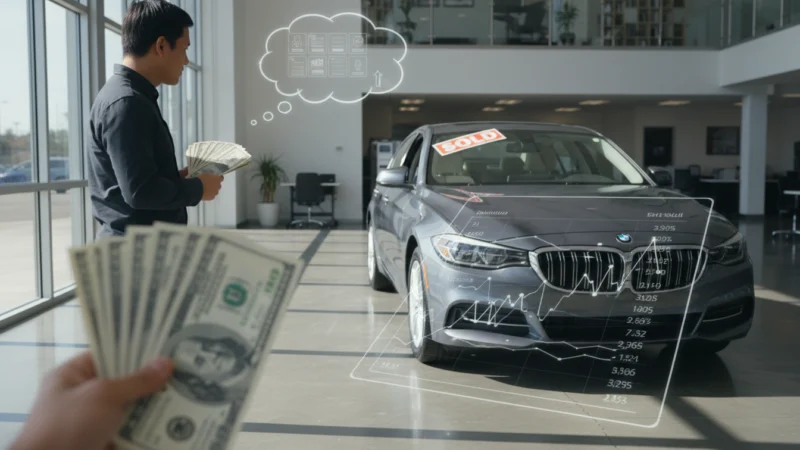
For example, if you can secure a car loan with a low interest rate, but you expect to earn a higher rate of return by investing your cash in the stock market or real estate, financing might be the financially savvier move. The earnings from your investment could potentially outweigh the interest you pay on the auto loan. This calculation requires a careful assessment of your risk tolerance and potential investment returns versus the guaranteed savings of avoiding loan interest.
How Does Your Choice Impact Your Credit Score?
Your decision to pay with cash or finance has a direct, though different, impact on your credit profile.
- Paying Cash: A cash purchase has no direct effect on your credit score. It is not reported to credit bureaus, so it neither helps nor hurts your score. However, it is a missed opportunity to add a positive installment loan to your credit history, which can be beneficial for your credit mix, especially for those with a thin credit file.
- Financing: Taking out a car loan has several effects. The initial application results in a hard inquiry, which can temporarily dip your score by a few points. More importantly, making on-time payments every month will build a positive payment history, which is the single most important factor in your credit score. Conversely, late or missed payments will significantly damage your score.
Negotiating Your Car Price: Does Cash Still Give You an Edge?
A common myth is that showing up with cash gives you the ultimate bargaining power at a dealership. In the modern auto market, this is often not the case. While private sellers almost always prefer cash, dealerships have complex revenue streams.
Dealerships often make a significant portion of their profit from the financing and insurance (F&I) office. They receive a commission or a flat fee from the lender for arranging your loan. Because of this, a customer who finances through the dealership can sometimes be more profitable to them than a cash buyer. The best negotiation tactic is not to declare you’re a cash buyer upfront. Instead, negotiate the vehicle’s purchase amount first, as if you are open to financing. Securing pre-approved financing from your own bank or credit union before you shop puts you in the strongest position, as it shows you are a serious buyer and gives you a benchmark rate to compare against the dealer’s offer.
When Does Financing Make More Sense Than Paying Cash?
Despite the appeal of being debt-free, there are several scenarios where financing is the more logical and financially prudent choice.
- When Low APR Offers Are Available: If a manufacturer is offering promotional 0% or very low-interest financing (e.g., under 2-3%), it can be a smart move. Your money can likely earn a better return elsewhere, even in a high-yield savings account.
- To Preserve Your Emergency Fund: You should never deplete your emergency fund (typically 3-6 months of living expenses) to buy a car. If paying cash would leave you without this safety net, financing is the responsible option.
- To Build or Improve Your Credit: For individuals with a limited credit history or those recovering from past credit issues, a car loan with a record of on-time payments can be a powerful tool for improving their credit score.
- For High-Return Investment Opportunities: If you are a disciplined investor and are confident you can generate a return on your cash that is higher than the loan’s APR, financing allows you to put your capital to more productive use.
When Is Paying Cash the Unbeatable Option?
In other situations, the simplicity and certainty of a cash purchase make it the clear winner.
- If You Have Ample Savings: If you can buy the car and still have a fully funded emergency fund and other savings intact, paying cash is a great way to simplify your finances and avoid interest.
- When Facing High Interest Rates: If your credit score is low and the only loans you qualify for have high APRs, the amount of interest you’d pay would be substantial. In this case, paying cash saves you a significant sum.
- For Budgeting Simplicity: Some people simply prefer the peace of mind that comes with having no car payment. If you value being debt-free and want to eliminate that monthly obligation, cash is the way to go.
- When Buying from a Private Seller: Most private party sales are cash-only transactions. Arranging financing for a private sale is more complex, and sellers strongly prefer the simplicity of a cash deal.
Frequently Asked Questions
- Is it better to pay cash for a car or finance it?
- Neither is universally better; it depends on your financial situation. Cash is ideal if you have substantial savings beyond an emergency fund and want to avoid debt. Financing is often smarter if you secure a low interest rate and can use your cash for investments, or if you need to build your credit history.
- Do car dealers prefer cash or financing?
- Many dealers prefer customers who finance because they can earn a commission from the lender for arranging the loan. A buyer with a pre-approved loan from an outside bank is often in the strongest negotiating position, as they are a guaranteed sale without relying on the dealer’s financing.
- What are the main disadvantages of paying cash for a car vs financing?
- The primary disadvantage of paying cash is the significant reduction in your liquid savings, which could be needed for emergencies. It also represents an opportunity cost, as that money could have been invested to generate a return. For financing, the main drawback is paying more over time due to interest.
- Can paying cash for a car hurt your credit score?
- Paying cash does not directly hurt your credit score, as the transaction isn’t reported to credit bureaus. However, it is a missed opportunity to build positive credit history with an installment loan, which can be valuable for improving your credit mix and overall score.
- How much cash should you have before buying a car?
- Before buying a car with cash, you should have enough to cover the full purchase amount, including taxes and fees, while still maintaining a separate, fully-funded emergency fund. A common guideline for an emergency fund is three to six months’ worth of essential living expenses.
Conclusion
The debate over paying cash for a car vs financing doesn’t have a single right answer. The optimal choice is deeply personal and depends on your savings, credit profile, investment opportunities, and comfort level with debt. By carefully evaluating the pros and cons of each method, assessing the available interest rates, and considering the opportunity cost of your cash, you can make a decision that aligns with your long-term financial well-being. Before heading to the dealership, review your budget and get a pre-approved loan offer to ensure you are in the strongest possible position to make a smart purchase.