
Every vehicle owner knows that even the smallest parts can make a big difference in how your car runs. One small part, the spark plug, has a big impact on engine performance, fuel efficiency, and even how easily your car starts in the morning. But few drivers realize the importance of the spark plug gap—the tiny space between the center and ground electrodes. This gap isn’t the same for every vehicle, and using the wrong gap can lead to rough idling, poor acceleration, or even engine damage. If you’re searching for a clear, reliable spark plug gap chart by vehicle, this guide will help you find the right information, understand why it matters, and give you tips for getting it right every time.
Why Spark Plug Gap Matters
The spark plug gap is the distance where the spark jumps to ignite the air-fuel mixture in your engine. If the gap is too small, the spark may be weak, leading to incomplete combustion and lower power. If the gap is too wide, the spark might not jump at all, especially when the engine is cold or under load. Manufacturers design each engine with a specific gap in mind to balance power, efficiency, and reliability.
Many modern engines use platinum or iridium spark plugs that keep their gap longer, but even these can wear out or be accidentally bumped during installation. Always check the gap before installing new plugs, even if they say “pre-gapped.”
Understanding Spark Plug Gaps: The Basics
Most spark plug gaps are measured in thousandths of an inch (for example, 0.044” means 44 thousandths of an inch). Some manufacturers use millimeters (mm). A typical gap range is 0.028”–0.060” (0.7–1.5 mm), but always check your vehicle’s manual for the exact number. Using the correct gap means:
- Better fuel efficiency
- Smoother engine idle
- Lower emissions
- Easier engine start
- Longer spark plug life
One less-known fact: turbocharged engines often require a slightly smaller gap to avoid misfire under boost, while older engines without electronic ignition sometimes need a larger gap.
Credit: www.championautoparts.com
How To Find Your Vehicle’s Spark Plug Gap
The fastest way is to check your owner’s manual or a reliable online source. But what if you don’t have the manual? You can look up charts based on your vehicle’s make, model, and year.
Here’s a quick look at how spark plug gap recommendations can change:
| Engine Type | Typical Gap Range (inches) | Notes |
|---|---|---|
| Older Carbureted | 0.032 – 0.035 | Larger gap for weaker ignition |
| Modern Fuel Injection | 0.040 – 0.045 | Standard for most cars 1990s+ |
| Turbocharged | 0.028 – 0.032 | Smaller gap to prevent misfire |
| Performance Engines | 0.040 – 0.060 | Depends on ignition upgrades |
Common Spark Plug Gaps By Popular Vehicle Brands
Every car is different, but some general trends exist. Here’s a reference chart for common makes and models. This is a starting point—always double-check for your exact engine and year.
| Brand | Popular Model/Year | Recommended Gap (inches) |
|---|---|---|
| Ford | F-150 (2015–2020) | 0.031 – 0.033 |
| Toyota | Camry (2012–2022) | 0.043 – 0.044 |
| Chevrolet | Silverado 1500 (2014–2021) | 0.040 |
| Honda | Civic (2010–2020) | 0.044 |
| Hyundai | Elantra (2015–2021) | 0.044 |
| Nissan | Altima (2013–2021) | 0.044 |
| Volkswagen | Jetta (2011–2022) | 0.028 – 0.032 |
| Subaru | Outback (2015–2021) | 0.044 |
| BMW | 3 Series (2012–2020) | 0.032 |
| Ram | 1500 (2013–2021) | 0.043 |
Tip: Even within one brand or model, different engines may require different gaps. For example, a 2015 Ford F-150 with a 3.5L EcoBoost engine uses 0.030”, while the same year’s 5.0L V8 uses 0.044”.
How To Check And Adjust Spark Plug Gap
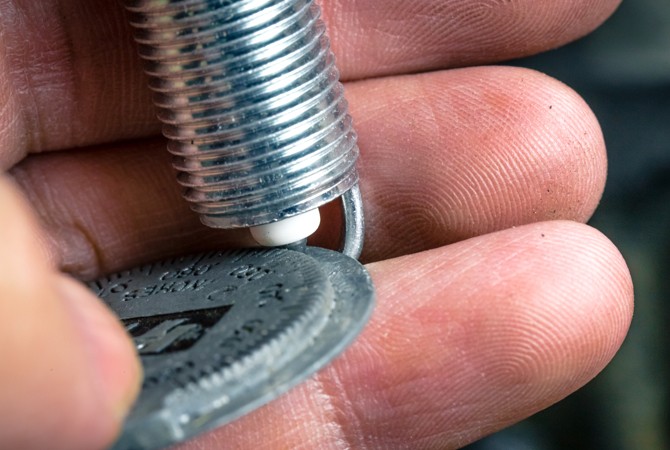
You don’t need fancy tools to check the gap—a basic feeler gauge or gap tool works. Here’s how to do it step by step:
- Remove the Spark Plug: Use a socket wrench and be gentle.
- Clean the Plug: Wipe off soot or oil.
- Insert the Feeler Gauge: Slide the correct blade into the gap. It should slide with slight resistance.
- Adjust the Gap: If the gap is too small, gently bend the ground electrode outward. If too large, tap it inward. Do not hit the center electrode.
- Double-Check: Re-measure the gap to confirm accuracy.
- Reinstall: Use a torque wrench if possible; overtightening can damage threads.
Non-obvious insight: Never adjust the gap on iridium or fine-wire platinum plugs unless the manufacturer says it’s safe. The fine tip can break easily.
Real-world Examples: Spark Plug Gap By Vehicle
Let’s look at specific gap recommendations for popular cars and trucks. This helps you see how much gaps can vary:
- 2018 Toyota Camry 2.5L: 0.044”
- 2016 Honda Accord 2.4L: 0.044”
- 2017 Ford F-150 3.5L EcoBoost: 0.030”
- 2019 Chevrolet Silverado 5.3L: 0.040”
- 2015 Subaru Forester 2.5L: 0.044”
- 2020 Nissan Altima 2.5L: 0.044”
- 2018 Volkswagen Golf 1.4T: 0.028”
- 2017 Hyundai Sonata 2.4L: 0.044”
- 2021 Ram 1500 5.7L HEMI: 0.043”
- 2013 BMW 328i 2.0L Turbo: 0.032”
Why do turbo cars (like VW Golf, BMW 328i) use a smaller gap? The answer is that high cylinder pressure can blow out a large spark, causing misfire. A small gap helps keep the spark strong.
.jpg)
Credit: noelsautoparts.com.au
When And Why To Change The Spark Plug Gap
Many drivers think spark plugs are “set and forget.” But gaps can change over time due to:
- Wear on electrodes
- Vibration from the engine
- Improper installation
- Using the wrong plug type
Signs you may have the wrong gap include:
- Rough idle or hesitation
- Trouble starting
- Drop in fuel economy
- Check Engine Light (sometimes for “misfire” codes)
Pro tip: Always check the gap on new plugs before installation, even if the box says “pre-gapped.” Shipping and handling can accidentally change the gap.
Special Cases: Performance, Turbo, And Old Engines
Not every car fits the standard chart. Here are some special situations:
Performance Engines
High-performance ignition systems can handle a wider gap, which can increase power and efficiency. But if you add a turbo or supercharger, you might need to close the gap slightly to avoid misfire.
Turbocharged Cars
Small gaps (as low as 0. 025”) are often recommended because high boost pressure makes it harder for the spark to jump.
Classic Cars
Older engines with points ignition (not electronic) sometimes need a wider gap (up to 0. 040” or 1. 0mm) to help fire a weaker spark.
Non-obvious insight: Upgrading your ignition coil or switching to electronic ignition can let you use a wider gap for better performance.
How To Use A Spark Plug Gap Chart
A chart is a starting point, but always:
- Match the chart to your exact engine (not just make/model)
- Check the spark plug box or manufacturer’s website for recommendations
- Adjust for modifications (turbo, ignition upgrades, performance mods)
If you’re unsure, use the lower end of the gap range—it’s safer for cold starts and avoids misfire.
Mistakes To Avoid
Many beginners make these errors:
- Using the gap for the wrong engine or year
- Not checking the gap on new plugs
- Forcing the gap open or closed, damaging the fine wire tip
- Using a coin-style gap tool on iridium plugs (can break the electrode)
- Not re-torquing plugs properly

Credit: www.scribd.com
Signs Of Incorrect Spark Plug Gap
If your gap is wrong, you might see:
- Misfires
- Engine hesitation
- Poor fuel economy
- Hard starting
- Check engine light
If These Happen After A Plug Change, Double-check The Gap!
Where To Find Reliable Gap Data
Vehicle manuals are best, but you can also check:
- Manufacturer websites (NGK, Denso, Bosch, Champion)
- Trusted auto parts stores
- Forums for your car model
- Wikipedia (for general info and references)
Frequently Asked Questions
What Happens If I Use The Wrong Spark Plug Gap?
A gap too small can cause weak spark and poor performance. A gap too large can cause misfires, especially in turbo engines. Both hurt fuel economy and may trigger warning lights.
How Often Should I Check My Spark Plug Gap?
Check every time you install new plugs. For most modern cars, you don’t need to re-gap between plug changes unless you have driveability issues.
Can I Use The Same Gap For All Spark Plug Brands?
No—always match the gap to your vehicle, not the brand. Different brands may have slightly different designs, but the gap must fit your engine’s needs.
Do Pre-gapped Spark Plugs Need To Be Checked?
Yes! Shipping and handling can change the gap, so always double-check with a feeler gauge before installing.
Is A Smaller Gap Always Better For Performance?
Not always. Too small a gap can reduce combustion efficiency. Use the manufacturer’s recommendation, or close the gap only if you have misfire with a turbo or high-boost engine.
Finding the right spark plug gap for your vehicle is simple but important. Take a few minutes to check the chart, measure the gap, and adjust as needed. Your engine will thank you with smoother starts, more power, and better fuel economy.