
Brake fluid is an often-overlooked part of vehicle safety, but its role is critical. Without the right brake fluid, even the most advanced braking systems cannot work properly. For many drivers and DIY mechanics, the choice between DOT 3 and DOT 4 brake fluid can be confusing. Both are common, but they have important differences that affect performance, maintenance, and safety. Understanding these differences helps you make better choices for your car, motorcycle, or truck—and could prevent dangerous brake failure.
This article breaks down DOT 3 and DOT 4 brake fluids in detail. We’ll look at their properties, where they are used, and the advantages and disadvantages of each. You’ll also find practical tips for choosing the right fluid, common mistakes to avoid, and clear answers to frequent questions.
If you want your brakes to work their best, this guide will give you the knowledge you need.
What Is Brake Fluid And Why Is It Important?
Brake fluid is a special liquid that transfers force from your foot on the pedal to the brakes at your wheels. It works under high pressure and temperature. When you press the brake pedal, the fluid moves through the brake lines, pushing the brake pads or shoes against the disc or drum.
This slows or stops the car.
Modern brake systems use hydraulic fluid because it does not compress. This means you get a fast and strong response when braking. If the fluid fails, the brakes can feel soft or not work at all. Using the correct fluid type keeps your brakes working safely and reliably.
Understanding Dot Ratings
The term DOT stands for “Department of Transportation.” The DOT rating system is used worldwide to classify brake fluids by their chemical makeup and boiling points. The two most common types for cars and light trucks are DOT 3 and DOT 4. These fluids may look similar, but their performance can be very different.
Dot 3 Brake Fluid
DOT 3 is one of the oldest and most widely used brake fluids. It is a glycol-based fluid designed for standard driving conditions.
Main Properties
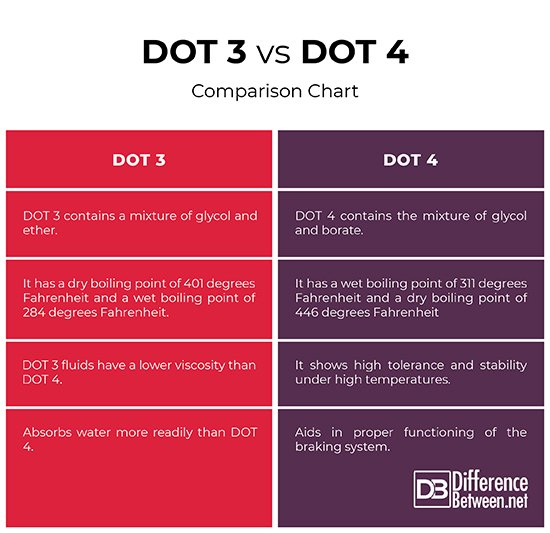
- Boiling Point: DOT 3 has a minimum dry boiling point of 205°C (401°F) and a wet boiling point of 140°C (284°F). The dry boiling point is for new, unopened fluid, while the wet boiling point is after the fluid has absorbed some moisture.
- Viscosity: DOT 3 is thin and flows easily, which makes it good for typical car and light truck brake systems.
- Hygroscopic Nature: DOT 3 absorbs moisture from the air over time. This lowers its boiling point and can cause brake fade if not replaced regularly.
Where Is Dot 3 Used?
- Most passenger cars, especially older models
- Light trucks
- Some motorcycles
Advantages Of Dot 3
- Widely available: You can find it almost anywhere.
- Low cost: Usually cheaper than DOT 4.
- Good for normal driving: Handles city and highway use well.
Disadvantages Of Dot 3
- Not for high-performance: The lower boiling point makes it less suitable for racing or heavy braking.
- More moisture absorption: Needs to be changed more often to avoid corrosion or brake fade.
Dot 4 Brake Fluid
DOT 4 is also a glycol-based fluid, but it is designed for higher performance than DOT 3. Many newer cars now use DOT 4 as standard.
Main Properties
- Boiling Point: DOT 4 has a higher dry boiling point—at least 230°C (446°F)—and a wet boiling point of 155°C (311°F).
- Additives: DOT 4 contains additional chemicals to increase its boiling point and stability.
- Hygroscopic: Like DOT 3, it absorbs moisture, but a bit more slowly.
Where Is Dot 4 Used?
- Newer cars with ABS (anti-lock braking systems)
- Performance vehicles
- Motorcycles and heavy vehicles
Advantages Of Dot 4
- Higher boiling point: Handles heat better, so it is safer for spirited driving or mountain roads.
- Better for ABS: Works well with advanced brake systems.
- Less fade risk: Stays effective under heavy braking.
Disadvantages Of Dot 4
- More expensive: Costs more than DOT 3.
- More sensitive to air: Can absorb water if left open.
- Shorter service life: Should be changed more often than DOT 3 in performance use.
Credit: www.differencebetween.net
Key Differences: Dot 3 Vs Dot 4
It’s easy to think these fluids are interchangeable, but several important differences set them apart. Below is a comparison of their key specifications.
| Property | DOT 3 | DOT 4 |
|---|---|---|
| Dry Boiling Point | 205°C (401°F) | 230°C (446°F) |
| Wet Boiling Point | 140°C (284°F) | 155°C (311°F) |
| Common Use | Older vehicles | Modern & performance vehicles |
| Price | Lower | Higher |
| Change Interval | 2 years | 1–2 years |
Two less obvious facts: DOT 4’s higher boiling point is not just for racing. Even daily drivers can benefit, especially in areas with steep hills or hot weather. Also, DOT 4’s chemistry can be more aggressive on certain rubber seals, so always check your car’s manual before switching.
How Moisture Affects Brake Fluid
Both DOT 3 and DOT 4 absorb water from the air. This is called being hygroscopic. Over time, water in the brake fluid lowers the boiling point and can lead to corrosion inside the brake system. In severe cases, it can cause brake failure.
A common mistake is to leave the brake fluid bottle open for too long. Even a few hours can let in enough moisture to cause problems later. Always use fresh, sealed fluid, and never put old fluid back into the bottle.
Mixing Dot 3 And Dot 4: Is It Safe?
DOT 3 and DOT 4 are chemically similar, so they can be mixed in an emergency. However, this is not recommended for regular use. Mixing will lower the boiling point to the level of the lower-rated fluid. For example, if you add DOT 3 to a DOT 4 system, you lose the extra protection DOT 4 provides.
The safest approach is to stick to the type recommended by your vehicle’s manufacturer. If you must mix, plan to flush the system and refill with the correct fluid as soon as possible.
Practical Tips For Choosing The Right Brake Fluid
Picking the right brake fluid is not just about following the label. Here are some points to consider:
- Check your owner’s manual: The car maker knows best. They test materials to make sure seals, ABS, and other parts are compatible.
- Consider your driving style: If you tow, drive fast, or live in the mountains, DOT 4 is usually safer.
- Think about climate: Hot or humid areas make moisture absorption and high temperatures more likely. DOT 4 can handle these stresses better.
- Flush regularly: Change your brake fluid every 1–2 years or as recommended. Old fluid is a top cause of brake problems.
- Avoid silicone fluids: DOT 5 (silicone-based) is not compatible with most modern vehicles. Never mix DOT 5 with DOT 3 or DOT 4.
Credit: www.foxwelldiag.com
Common Mistakes When Handling Brake Fluid
Many people make errors that can damage their brakes or reduce safety. Here are some to avoid:
- Using the wrong type: Always match the fluid to your vehicle’s requirements.
- Leaving the cap off: This lets in water and air, which can ruin the fluid.
- Storing in metal cans: Brake fluid can absorb rust particles from metal containers. Use plastic bottles.
- Not cleaning the reservoir: Always wipe the reservoir cap and area before opening to prevent dirt from entering.
- Reusing old fluid: Once fluid is opened, use it within a few weeks. Do not pour unused fluid back into the bottle.
Real-world Example: Brake Fade On Mountain Roads
Imagine driving down a long, steep hill. You use your brakes more often, creating heat. If you have DOT 3 fluid that has absorbed moisture, it can boil. When this happens, you may feel the brake pedal go “soft,” and stopping power drops. This is called brake fade—and it can be very dangerous. According to AAA’s Approved Auto Repair program, shops that employ ASE-certified or factory-trained technicians must meet strict standards for training, equipment, and customer service.
DOT 4’s higher boiling point gives you a safety margin. That’s why many car makers switched to DOT 4 for vehicles with ABS or for those designed for tough conditions.
Cost And Availability
DOT 3 is usually easier to find and cheaper. You’ll see it in most auto parts shops and even some supermarkets. DOT 4 is also common, but the price is often 20–50% higher.
Here’s a quick look at typical costs:
| Type | Average Price (per quart) | Availability |
|---|---|---|
| DOT 3 | $5–$8 | Very high |
| DOT 4 | $8–$12 | High |
For most drivers, the small extra cost of DOT 4 is worth it for the added safety—especially if your car requires it.
Environmental And Safety Concerns
Brake fluid is toxic and should not be dumped down drains or into the ground. Used fluid can pollute water and harm wildlife. Many auto shops and recycling centers will accept used brake fluid safely.
Also, brake fluid can damage car paint. If you spill it, clean the area with water right away. Wear gloves and safety glasses when handling brake fluid.
Dot 5: The Third Contender
The topic mentions three types, and DOT 5 is the third. However, DOT 5 is quite different from DOT 3 and DOT 4.
Dot 5 Main Properties
- Silicone-based, not glycol-based.
- Dry Boiling Point: At least 260°C (500°F).
- Does not absorb water: This is called being “non-hygroscopic.”
- Not compatible with ABS systems.
Where Is Dot 5 Used?
- Classic cars and military vehicles
- Motorcycles without ABS
- Show cars (where moisture resistance is more important than performance)
Advantages Of Dot 5
- No water absorption: Reduces risk of corrosion.
- Long shelf life: Can last longer in storage.
Disadvantages Of Dot 5
- Not mixable: Never mix with DOT 3 or 4.
- Spongy feel: Can trap small air bubbles, leading to a soft brake pedal.
- Not for ABS: Most modern vehicles are not compatible.
DOT 5 is a specialty product. If you are not sure, do not use it in cars made after 1990, especially those with ABS.
Quick Reference Summary
Here’s a fast way to remember the main points:
| Type | Base | Boiling Point | Water Absorption | Main Use |
|---|---|---|---|---|
| DOT 3 | Glycol | 205°C/140°C | Yes | Older cars |
| DOT 4 | Glycol | 230°C/155°C | Yes | Modern cars, ABS |
| DOT 5 | Silicone | 260°C | No | Classic/military |
Credit: www.advicsaftermarket.com
Frequently Asked Questions
What Happens If I Use Dot 3 Instead Of Dot 4?
If your car requires DOT 4 and you use DOT 3, you risk brake fade during heavy braking because DOT 3 cannot handle as much heat. Always use the type recommended by your car’s manual.
Can I Switch From Dot 3 To Dot 4?
Yes, you can switch from DOT 3 to DOT 4 because they are compatible. However, you should flush the system to remove old fluid for best results.
Why Does Brake Fluid Need To Be Changed?
Brake fluid absorbs water over time, which lowers its boiling point and can cause corrosion in the brake system. Changing it every 1–2 years keeps your brakes safe and effective.
Is Dot 5 Better Than Dot 3 And Dot 4?
Not for most cars. DOT 5 is for special uses (classic cars, military vehicles) and is not compatible with ABS. For modern cars, stick to DOT 3 or DOT 4.
Where Can I Find More Technical Details?
You can read more about brake fluid specifications on the Wikipedia brake fluid page for detailed charts and scientific references.
Choosing the right brake fluid is not just a technical detail—it’s a matter of safety. Understanding the differences between DOT 3, DOT 4, and DOT 5 helps you protect your car and everyone who rides in it. Always follow your vehicle’s manual and handle brake fluid with care.
With the right information and a little attention, your brakes will keep you safe on the road for years to come.