
Parasitic Battery Drain Test: How to Detect and Fix Power Loss in Your Car
Have you ever left your car parked overnight and found the battery dead in the morning? It’s frustrating and inconvenient, but it often happens due to a hidden issue called parasitic battery drain. This problem can slowly drain your battery, even when the car is turned off. Many drivers don’t realize how common it is, or that a simple test can save hours of guesswork and costly repairs.
A parasitic battery drain test helps you find out if something in your car is using power when it shouldn’t. This article will walk you through everything you need to know: what causes parasitic drains, how to run a complete test, the tools you need, and the steps to fix the problem. By the end, you’ll feel confident tackling this issue yourself—or at least understanding what your mechanic is talking about.
What Is Parasitic Battery Drain?
A parasitic drain happens when electrical devices or systems continue to draw power from your car’s battery even after the engine is turned off. Every vehicle has some normal drain, for things like the clock, security systems, or the radio memory. But when something is faulty or left on, the drain becomes excessive. This can leave you with a dead battery, sometimes in just a few hours or overnight.
Normal battery drain is usually 20-50 milliamps (mA). Anything over 50 mA is considered abnormal and can cause problems over time.
Common Symptoms
- Car won’t start after being parked for a while
- Battery frequently needs jump-starting
- Dim or flickering interior lights
- Clicking sound instead of engine turnover
Why Parasitic Battery Drain Happens
Understanding the causes can help you prevent future problems. Here are some of the most frequent reasons:
- Glove box or trunk lights left on due to a stuck switch
- Faulty relays that keep circuits active
- Aftermarket accessories (alarms, stereos) not wired correctly
- ECU or control module errors that don’t go to sleep
- Corroded or damaged wiring causing short circuits
- Chargers or devices left plugged into 12V outlets
Even a tiny LED or sensor can drain the battery if it runs all night. Modern cars with many electronic systems are especially at risk.
Tools Needed For A Parasitic Battery Drain Test
Before you start, gather these tools for a safe and accurate test:
- Digital multimeter (with a 10A current range)
- Basic hand tools (wrenches, screwdrivers)
- Gloves and safety glasses
- Notepad or smartphone to record readings
Optional but helpful:
- Amp clamp meter for easier current measurement
- Fused jumper wire to avoid losing radio codes or system memory
How To Perform A Parasitic Battery Drain Test
Let’s get practical. Here’s how you can carry out the test step by step.
Step 1: Prepare Your Vehicle
- Turn off the engine and remove the key
- Close all doors, trunk, and glove box (make sure lights turn off)
- Wait at least 10–30 minutes for all modules to go to sleep
Step 2: Disconnect The Battery
- Open the hood and locate the battery
- Remove the negative (-) terminal using a wrench
- Be careful not to let the wrench touch other metal parts
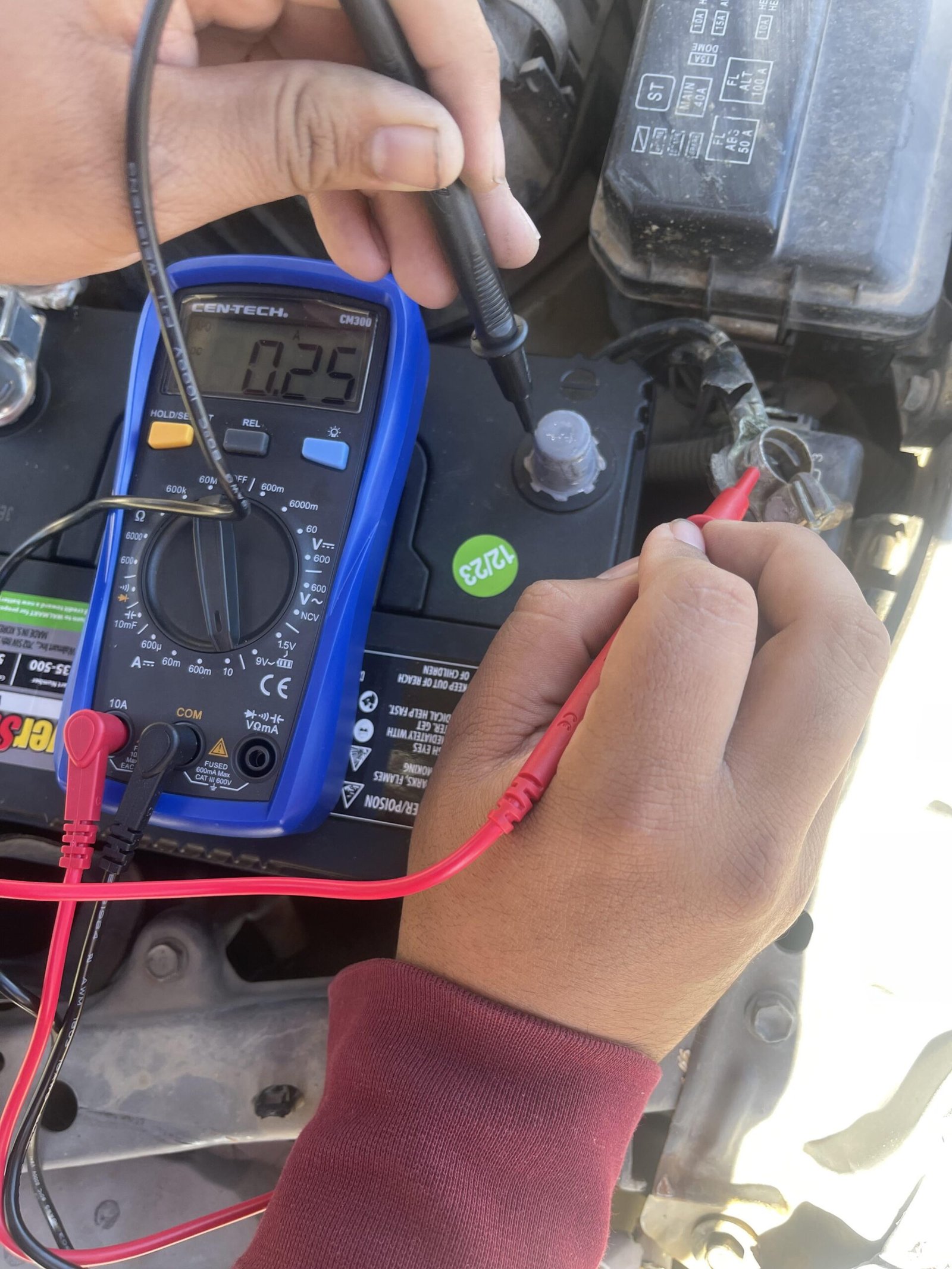
Step 3: Connect The Multimeter
- Set your digital multimeter to the highest amps (A) setting
- Connect one lead to the negative battery post, the other to the removed cable
- Make sure you have a solid connection—loose connections may give false readings
Step 4: Read The Current Draw
- Check the multimeter display
- A normal reading is 20-50 mA (0.02–0.05 A)
- Anything above 50 mA means there is an abnormal drain
Step 5: Identify The Faulty Circuit
- Keep the multimeter connected
- Open the vehicle fuse box (usually under the hood or dash)
- One by one, pull out each fuse and watch the reading
- When the reading drops sharply, you’ve found the circuit causing the drain
Step 6: Trace The Problem
- Note which fuse caused the drop
- Check the car’s manual to see what systems use this fuse
- Inspect related components (switches, relays, lights, modules) for faults
Step 7: Fix The Issue
- Repair, replace, or disconnect the faulty part
- Re-test to confirm the drain is gone
- Reconnect the battery and reset any lost settings

Credit: www.fluke.com
Comparing Normal And Abnormal Drain Values
Here’s a quick reference for what’s normal and what’s not:
| Current Draw (mA) | Status | Impact |
|---|---|---|
| 0–20 | Excellent | No battery risk |
| 21–50 | Normal | Safe for most cars |
| 51–100 | High | Possible long-term issues |
| Over 100 | Abnormal | Battery will drain quickly |
If your reading is above 100 mA, you likely have a serious parasitic drain that needs immediate attention.
Real-world Example: Finding A Hidden Drain
Let’s say your car’s battery dies every few days. You do a parasitic drain test and see a current draw of 180 mA. After pulling fuses one by one, you notice the draw drops to 30 mA when you remove the fuse for the interior lights. You check the glove box and find the light stays on, even when closed—a simple stuck switch. Fixing this small part solves the problem.
Tips For Accurate Testing
- Always check that your multimeter is set to the correct range before connecting
- Don’t open doors or operate switches during the test; this can “wake up” the car’s systems and give false readings
- If you disconnect the battery, you may lose radio presets or alarm settings
- On newer cars, some modules take longer to sleep—wait at least 30 minutes before measuring
- Take a photo of the fuse box layout for easier reassembly
Parasitic Drain In Modern Cars
Modern vehicles are packed with computers, sensors, and electronic features. Some systems, like keyless entry or anti-theft devices, draw more power than older cars. Even when off, these modules can cause a standby current of 50–100 mA.
Here’s a comparison of typical standby drain in different vehicle types:
| Vehicle Type | Year | Typical Standby Drain (mA) |
|---|---|---|
| Classic Sedan | 1995 | 10–20 |
| Mid-2000s SUV | 2005 | 30–50 |
| Modern Hybrid | 2022 | 60–120 |
This shows why battery drain is a bigger challenge in newer cars. Always check your owner’s manual for the expected standby current for your specific model.
Credit: www.reddit.com
Mistakes To Avoid During Parasitic Drain Testing
Many people make simple errors that can waste time or even damage the car:
- Using the wrong multimeter setting: Always set to Amps, not Volts or Ohms.
- Testing too soon after shutdown: Wait for all systems to sleep.
- Opening doors while testing: This wakes up modules and increases current.
- Not recording fuse positions: You may forget which fuse goes where.
- Ignoring small drains: Even 80 mA can kill a battery in a few days.
If you’re unsure, it’s best to ask for help or refer to a mechanic.
Preventing Parasitic Battery Drain
Prevention is better than cure. Here are steps you can take to reduce the risk:
- Unplug chargers and devices when not in use
- Check lights (interior, trunk, glove box) regularly
- Close doors and trunk firmly every time
- Maintain wiring and replace corroded terminals
- Service relays and switches if you notice flickering or strange behavior
If you install aftermarket devices, make sure they are wired correctly and have a good ground.

Credit: wataru-s.jp
When To See A Professional
Sometimes, the problem is too complex or hidden deep in the car’s electronics. If you’ve tried the above steps and still have a drain, it may be time to visit a trusted mechanic. They have advanced tools like thermal cameras and scan tools that can locate issues quickly.
For more on automotive electrical systems, you can visit the Automotive Electrical System Wikipedia page.
Frequently Asked Questions
What Is The Most Common Cause Of Parasitic Battery Drain?
The most common causes are stuck switches (like glove box or trunk lights), faulty relays, and aftermarket accessories that are not wired correctly. Even simple things like leaving a phone charger plugged in can slowly drain the battery.
How Long Does It Take For A Parasitic Drain To Kill A Battery?
It depends on the size of the drain and the health of the battery. A drain of 100 mA can discharge a standard car battery in a few days. Severe drains over 500 mA might kill a battery overnight.
Can A Car Battery Recover After Being Drained By A Parasitic Load?
Sometimes, if the battery is new and healthy, it can recover after a full recharge. However, repeated deep discharges will shorten its life and may require replacement sooner.
Do I Need Special Tools For A Parasitic Drain Test?
The main tool you need is a digital multimeter that can measure current in Amps. Some newer vehicles may require an amp clamp or scan tool, but for most cars, a standard multimeter is enough.
Is It Safe To Perform A Parasitic Drain Test Myself?
Yes, if you follow safety steps: wear gloves, use the right tools, and avoid touching metal parts with the wrench. If you are unsure or uncomfortable, it’s always best to ask a professional.
Solving parasitic battery drain is all about patience and careful testing. By following the steps above, you can save yourself time, money, and the headache of being stranded with a dead battery. Remember, a little effort now can prevent big problems later.