
A truck’s towing capacity is the maximum weight it can safely pull, as determined by the manufacturer. This critical rating is based on the truck’s engine, transmission, frame, axles, and brakes. Exceeding this limit can lead to dangerous driving conditions, mechanical failure, and potentially void your vehicle’s warranty.
- Understand Key Terms: Learn the difference between GVWR, GCWR, and payload to make informed decisions.
- Find Your Specific Rating: Your truck’s true capacity is found on the doorjamb sticker and in the owner’s manual, not in advertisements.
- Calculate Your Real-World Limit: Your actual towing capacity is the Gross Combination Weight Rating (GCWR) minus the weight of your loaded truck.
- Prioritize Safety: Overloading your truck compromises braking, steering, and stability, putting you and others at risk.
What Is Truck Towing Capacity and Why Does It Matter?
Towing capacity is a crucial safety specification set by the vehicle manufacturer. It represents the absolute maximum weight of a trailer that a specific truck configuration can pull without compromising its structural integrity or its ability to safely accelerate, steer, and stop. This isn’t just a suggestion; it’s a fundamental limit engineered into the vehicle.
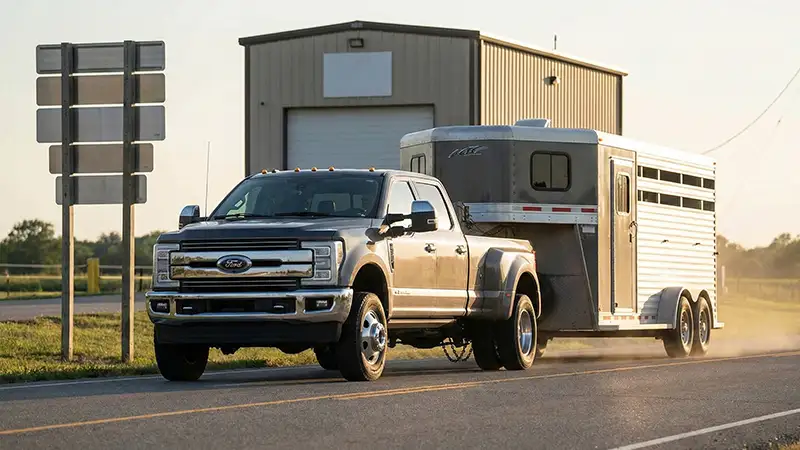
Ignoring this rating has serious consequences. It places immense stress on every major component, from the engine and transmission to the suspension and brakes. More importantly, it creates a significant safety hazard on the road. An overloaded truck is an unstable truck, prone to trailer sway, brake failure, and a complete loss of control.
Decoding Towing Terminology: GVWR, GCWR, Payload, and More
To understand towing, you must first understand the language. The acronyms on your doorjamb sticker and in your manual are the building blocks of safe towing. Misinterpreting them is a common and dangerous mistake.
Key Weight Ratings Explained
- Curb Weight: This is the weight of your truck with all standard equipment and necessary operating fluids (like fuel and oil), but with no passengers or cargo.
- Payload Capacity: This is the maximum weight of all cargo and passengers that you can carry in your truck’s cab and bed. It also includes the trailer’s tongue weight.
- Gross Vehicle Weight (GVW): This is the real-time, actual weight of your fully loaded truck. It’s the curb weight plus the weight of your passengers, cargo, and the trailer’s tongue weight. You can find this by driving your loaded truck onto a vehicle scale.
- Gross Vehicle Weight Rating (GVWR): This is the absolute maximum weight your truck is allowed to be, as determined by the manufacturer. Your GVW should never exceed your GVWR.
- Gross Combination Weight (GCW): This is the real-time, actual weight of your fully loaded truck AND your fully loaded trailer combined.
- Gross Combination Weight Rating (GCWR): This is the most important number for towing. It is the absolute maximum weight of your loaded truck and loaded trailer combined. Your GCW must never exceed the GCWR.
- Tongue Weight / Pin Weight: This is the downward force that the trailer coupler exerts on the truck’s hitch ball (conventional) or that the kingpin exerts on the in-bed hitch (5th-wheel/gooseneck). It should typically be 10-15% of the total trailer weight for conventional trailers and 15-25% for 5th-wheel/gooseneck trailers.
- Gross Axle Weight Rating (GAWR): This is the maximum weight that can be placed on an individual axle (front or rear).
How to Find Your Truck’s Exact Towing Capacity
The advertised “max towing” number is often for a very specific truck configuration that might not match yours. To find the true, safe towing capacity for your vehicle, you need to do a little research.
- Check the Compliance Sticker: Open the driver’s side door and look for the sticker on the doorjamb. This label, often called the “Tire and Loading Information” sticker, lists your truck’s specific GVWR and GAWR. This is the starting point for all calculations.
- Consult the Owner’s Manual: Your owner’s manual is the most reliable source of information. It contains detailed towing charts that list the GCWR for your specific model, engine, axle ratio, and drivetrain (4×2 vs. 4×4).
- Visit the Manufacturer’s Website: Most truck manufacturers provide online towing guides for recent model years. You can often input your Vehicle Identification Number (VIN) to get precise figures for your exact build.
- Do the Math: The most accurate way to determine your real-world towing capacity is with a simple calculation: GCWR – Your Truck’s Actual Weight = Max Loaded Trailer Weight. To find your truck’s actual weight, load it up with all passengers, pets, and cargo you plan to bring, and take it to a certified scale (found at truck stops or moving companies).
Conventional vs. 5th-Wheel/Gooseneck Towing: What’s the Difference?
The type of hitch you use dramatically impacts towing stability and capacity. The two main categories are conventional and in-bed systems like 5th-wheel and gooseneck hitches.
Conventional Towing
This is the most common method, using a receiver hitch mounted to the truck’s frame behind the rear bumper. The trailer attaches via a ball mount. It’s versatile and suitable for a wide range of loads, from small utility trailers to large travel trailers.
- Pros: Widely available, leaves the truck bed free for cargo, less expensive.
- Cons: Lower towing capacities, more susceptible to trailer sway.
5th-Wheel and Gooseneck Towing
These systems place the hitch point inside the truck bed, directly over the rear axle. A 5th-wheel uses a large, pivoting plate and a kingpin, similar to a semi-truck, while a gooseneck uses a ball and coupler. This placement distributes the trailer’s weight more effectively onto the truck’s frame and suspension.
- Pros: Much higher towing capacities, significantly improved stability and maneuverability, reduced trailer sway.
- Cons: Takes up significant bed space, more complex installation.
Your Complete Towing Capacity Guide for Trucks
Using this towing capacity guide for trucks effectively means looking beyond a single number. Safe towing is about managing a system of interconnected weights. You must ensure that you do not exceed any of your truck’s individual ratings: GVWR, GCWR, GAWR, or the hitch rating.
For example, you might be under your GCWR, but if the trailer’s tongue weight is too heavy, it could overload your truck’s rear axle (exceeding the rear GAWR) and its payload capacity (exceeding the GVWR). Always verify every rating. When in doubt, reduce the weight in your trailer or truck.
Essential Towing Equipment
Beyond the truck and trailer, certain equipment is vital for safety:
- Trailer Brake Controller: An electronic device in the cab that activates the trailer’s brakes in sync with the truck’s brakes. It is a legal requirement in most states for trailers over a certain weight.
- Weight Distribution Hitch: For conventional towing, this device uses spring bars to distribute the trailer’s tongue weight more evenly across the truck’s front and rear axles and the trailer’s axles, improving stability and steering control.
- Towing Mirrors: Extended mirrors are often necessary to see around the sides of a wide trailer, eliminating dangerous blind spots.
Key Factors That Determine a Truck’s Towing Power
A truck’s towing capacity is the result of a complex engineering balance. Several key components work together to determine how much it can pull safely.
- Engine: Torque is the critical figure for towing. Diesel engines typically produce more low-end torque than gasoline engines, making them ideal for pulling heavy loads from a standstill.
- Transmission: A robust transmission with a dedicated fluid cooler is essential to manage the heat and stress generated by towing. More gears can help keep the engine in its optimal power band.
- Axle Ratio: This refers to the gearing inside the rear differential. A higher numerical ratio (e.g., 4.10 vs. 3.55) provides more pulling power but typically results in lower fuel efficiency when not towing.
- Frame and Suspension: Heavy-duty trucks feature thicker, stronger frames and stiffer suspension components (leaf springs, shocks) designed to handle the immense forces of a heavy trailer.
- Brakes: Larger, more powerful brakes are needed to safely stop the combined mass of the truck and trailer.
- Cooling System: An uprated radiator, engine oil cooler, and transmission cooler are vital to prevent overheating under load.
Towing Capacity by Truck Class: From Mid-Size to Heavy-Duty
While you must always check your specific vehicle’s ratings, truck classes provide a general idea of towing capability.
Mid-Size Trucks
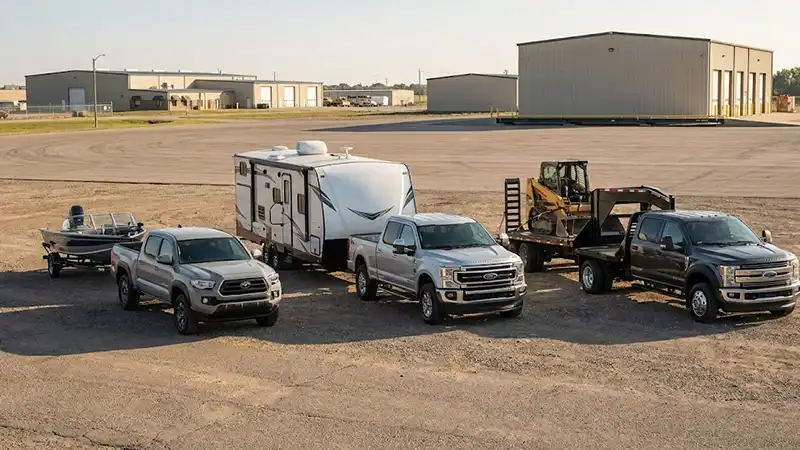
These trucks are perfect for lighter duties like pulling small boats, jet skis, or utility trailers. Their towing capacities typically fall in the 3,500 to 7,500-pound range.
Full-Size / Half-Ton Trucks
This is the most popular segment. Capacities vary widely based on configuration, but generally range from 7,000 pounds to over 13,000 pounds. They are capable of handling mid-size travel trailers, larger boats, and car haulers.
Heavy-Duty (HD) Trucks
Built for serious work, these trucks (2500/3500 series) are the choice for large 5th-wheel RVs, horse trailers, and heavy equipment. Conventional towing can exceed 20,000 pounds, while 5th-wheel/gooseneck ratings can surpass 35,000 pounds in some configurations.
The Dangers of Exceeding Your Towing Limit
Towing beyond your truck’s rated capacity is never safe. The risks are severe and can lead to catastrophic failure on the road.
- Loss of Control: The most immediate danger is trailer sway, a violent side-to-side oscillation that can cause you to lose control and jackknife or roll over.
- Brake Failure: Your truck’s brakes are designed to stop its GVWR, not an unlimited amount of weight. An overloaded trailer can overwhelm the brakes, leading to overheating, fade, and a dangerously long stopping distance.
- Component Failure: Overloading puts extreme stress on the transmission, axles, suspension, and frame. This can lead to sudden, catastrophic mechanical failure.
- Legal and Insurance Issues: If you are involved in an accident while overloaded, you can face significant fines and legal liability. Your insurance company may also deny your claim.
Frequently Asked Questions About Truck Towing Capacity
- What is the difference between towing capacity and payload?
- Towing capacity is the maximum weight your truck can pull behind it. Payload is the maximum weight your truck can carry in its cab and bed, which includes passengers, cargo, and the trailer’s tongue weight.
- Does payload affect my truck’s towing capacity?
- Yes, absolutely. The weight of your payload (passengers and cargo) is part of the truck’s total weight. This weight counts against the Gross Combination Weight Rating (GCWR), which directly reduces the amount of trailer weight you can safely pull.
- How do I use a towing capacity guide for trucks to find the right vehicle?
- First, determine the fully loaded weight of the trailer you intend to tow. Then, look for a truck with a towing capacity and GCWR that comfortably exceeds that weight by at least 15-20%. This safety margin accounts for cargo, passengers, and challenging road conditions.
- Can I increase my truck’s towing capacity?
- No, you cannot legally or safely increase the manufacturer’s official towing capacity (GCWR). While aftermarket parts like air bags or enhanced coolers can improve stability and performance *within* the rated limits, they do not change the fundamental ratings set by the engineers who designed the truck.
- Where is the most reliable place to find my truck’s towing capacity?
- The two most reliable sources are the official owner’s manual for your specific model year and the compliance sticker located on the driver’s side doorjamb. These sources provide the exact ratings for your vehicle as it left the factory.
- What does ‘max towing capacity’ mean in truck advertisements?
- “Max towing capacity” is a marketing figure that represents the highest possible rating for a particular model. It typically applies to a specific, often basic, configuration (e.g., a 2WD regular cab with a specific engine and axle ratio) and does not account for passengers, options, or cargo.
Conclusion
Understanding your truck’s towing capacity is a non-negotiable part of being a responsible owner. It is a system of critical safety ratings—including GCWR, GVWR, and payload—that must all be respected. Always prioritize the official figures found in your owner’s manual and on your doorjamb sticker over advertised numbers.
Before your next trip, take the time to verify your truck’s limits and weigh your loaded setup. A few minutes of preparation can prevent mechanical damage and ensure a safe journey for you and everyone else on the road.
{“@context”:”https://schema.org”,”@type”:”Article”,”headline”:”The Ultimate Towing Capacity Guide for Trucks: How Much Can You Really Tow?”,”mainEntityOfPage”:”https://autofixnotes.com/towing-capacity-guide-for-trucks/”,”datePublished”:”2025-12-07T05:52:51+00:00″,”dateModified”:”2025-12-07T05:52:51+00:00″}
