
If you drive a front-wheel drive car, tire wear is not random. The front tires do more work than the rear tires. They handle steering, most of the braking force, and most of the engine power. That means they wear faster, often in ways many drivers do not notice until the tires become noisy, shaky, or uneven.
A good Front Wheel Drive Tire Rotation Pattern helps spread that wear across all four tires. This can improve safety, extend tire life, and give you a smoother ride. It also helps keep traction balanced, which matters a lot in rain, cold roads, and sudden stops.
The key is not just rotating tires. The key is rotating them the right way, at the right time, and with a few small checks that many people skip. Done correctly, tire rotation is one of the cheapest ways to protect a bigger investment in your vehicle.
Why front-wheel drive tires wear differently
Front-wheel drive cars place a heavy job on the front axle. The front tires must push the car forward, turn the vehicle, and help stop it. Because of that, the front pair usually wears faster than the rear pair. This is normal, but it becomes a problem when the difference gets too large.
In many cases, front tires also wear in a more uneven way. The outer edges may wear faster if you make lots of turns. The inner or outer shoulder may wear faster if alignment is off. If tire pressure is wrong, wear can become worse and happen sooner.
Here are the main reasons front tires lose tread faster:
- Drive force from the engine
- Steering load during every turn
- Braking force on the front axle
- Higher weight transfer when you slow down
- More heat buildup in daily driving
One important detail many drivers miss is that front tires can look “fine” from a distance while still losing grip. Tread depth may still appear acceptable, but the tire may already have lost much of its wet-road performance. That is why regular rotation matters more than waiting until the tires look badly worn.
The best front wheel drive tire rotation pattern
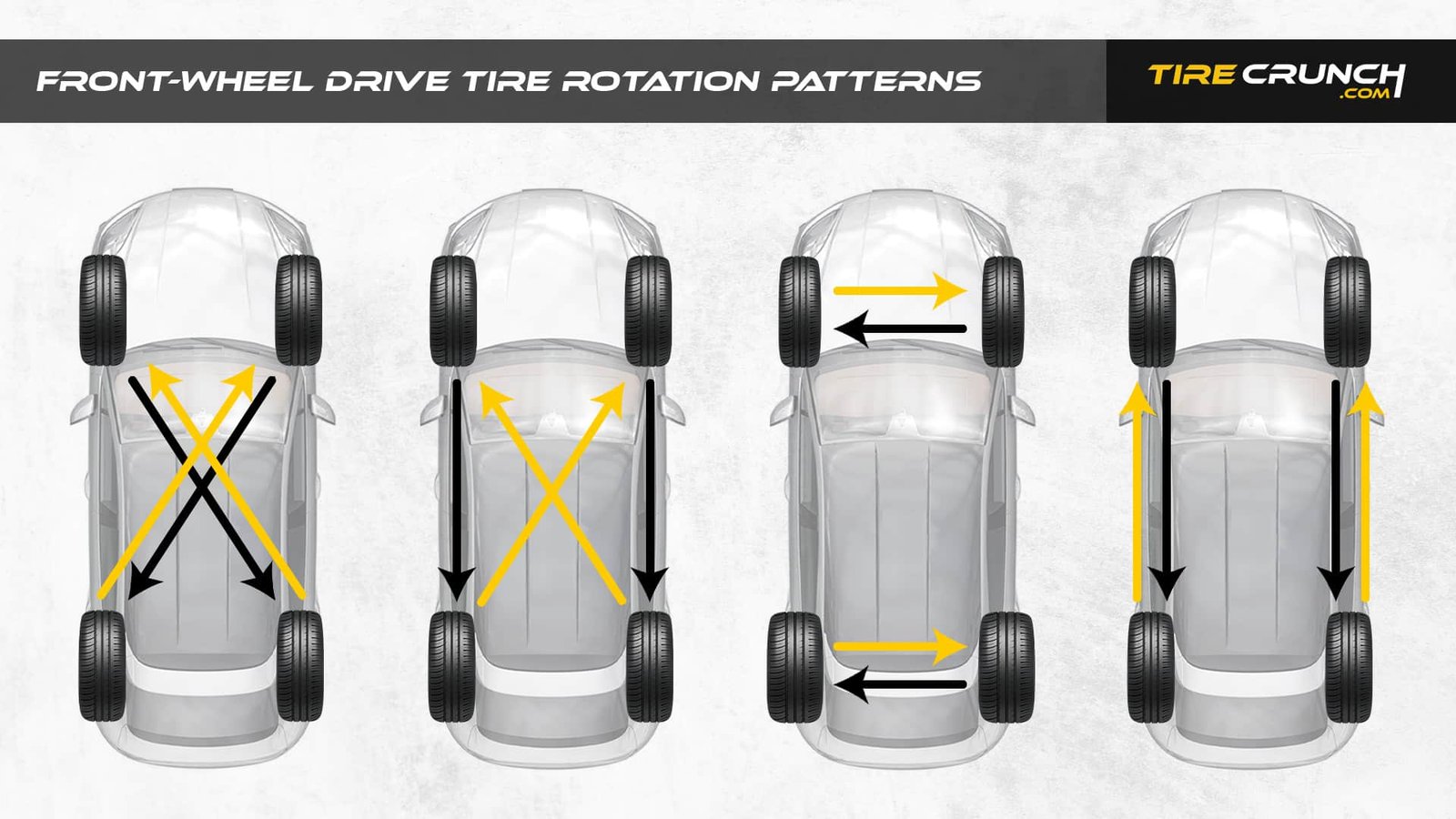
The most common Front Wheel Drive Tire Rotation Pattern is this: move the front tires straight to the rear, and move the rear tires to the front while crossing them to the opposite sides.
In simple words:
- Front left goes to rear left
- Front right goes to rear right
- Rear left goes to front right
- Rear right goes to front left
This pattern helps balance wear because the front tires stay on the same side as they move back, while the rear tires cross to help even out wear patterns. It works well for most front-wheel drive vehicles with non-directional tires.
If your car has directional tires, the pattern changes. Directional tires are made to spin in one direction only. In that case, tires usually move front to rear on the same side, unless the tires are removed from the wheels and remounted. Always check the sidewall for an arrow or rotation symbol.
When this pattern works best
This rotation pattern is best for vehicles with:
- Front-wheel drive layouts
- Non-directional tires
- Same-size tires on all four corners
- No staggered wheel setup
It is the most practical choice for many compact cars, sedans, hatchbacks, and small crossovers.
When the pattern should change
Some vehicles need a different approach. For example, if your tires are directional, staggered, or mixed in size, the standard cross pattern may not be right. Also, if one tire has unusual wear from a repair issue, a mechanic may recommend a different pattern to reduce noise or vibration.
One non-obvious point: a tire rotation pattern should match the goal, not just the vehicle type. If a front tire has mild edge wear from alignment problems, rotating it in the wrong direction may keep the issue alive instead of reducing it. That is why the tire condition matters as much as the car type.
How often to rotate tires on a front-wheel drive vehicle
Most front-wheel drive vehicles benefit from tire rotation every 5,000 to 7,500 miles. Many drivers use every oil change as a simple reminder, but the exact timing depends on driving habits, tire type, and road conditions.
If you drive in heavy traffic, make short trips, or often brake hard, your front tires will wear faster. If you travel on rough roads or carry heavy loads, the wear rate can also increase. In these cases, earlier rotation may be smart.
Here is a simple guide:
| Driving condition | Suggested rotation interval |
|---|---|
| Normal city and highway driving | Every 5,000 to 7,500 miles |
| Frequent stop-and-go traffic | Every 5,000 miles |
| Heavy loads or rough roads | Every 4,000 to 6,000 miles |
| Performance or aggressive driving | Check more often; rotate earlier if wear is uneven |
Do not wait too long. If the front tires become much more worn than the rear, rotation can no longer fully correct the difference. At that point, the tires may remain noisy or uneven even after being swapped.
Step-by-step tire rotation for front-wheel drive cars
Rotating tires is not difficult, but it should be done carefully. A rushed job can lead to cross-threaded lug nuts, uneven tightening, or a tire placed in the wrong position. Those mistakes can create safety risks.
Credit: tirecrunch.com
What you need
- Car jack
- Jack stands
- Lug wrench or impact tool
- Tire pressure gauge
- Owner’s manual
- Torque wrench if possible
Basic rotation steps
- Park on a flat, stable surface and engage the parking brake.
- Loosen the lug nuts slightly before lifting the car.
- Raise the vehicle and support it with jack stands.
- Remove the wheels one by one.
- Move the front tires straight to the rear on the same side.
- Move the rear tires to the front, crossing sides.
- Install the wheels and tighten the lug nuts by hand first.
- Lower the car and tighten the lug nuts to the correct torque.
- Check tire pressure and adjust it to the recommended level.
After the rotation, drive a short distance and listen for unusual noise or vibration. A small mistake in wheel installation can show up quickly.
For general maintenance guidance, the National Highway Traffic Safety Administration offers useful tire safety information.
Signs your tires need rotation sooner
Even if you follow a mileage schedule, your tires may need attention sooner. Real-world driving is not always equal. Some tires wear faster because of alignment issues, pressure problems, or road habits.
Watch for these signs:
- The front tires look smoother than the rear tires
- Steering feels less stable on wet roads
- Road noise has increased
- The car pulls slightly to one side
- You notice feathering, cupping, or edge wear
- The tread depth difference between front and rear is easy to see
One detail many beginners miss is that tire wear is not only about tread depth. The shape of the wear matters too. A tire may still have decent tread but already show cupping or uneven shoulder wear. Once that happens, rotation alone may not solve the root problem.
Common mistakes people make with front wheel drive tire rotation
Many tire problems come from small mistakes, not big ones. A driver may believe the tires were rotated, but the wrong pattern was used or the tires were not inflated afterward. That can reduce the value of the service.
1. Using the wrong pattern for directional tires
Directional tires must roll in one direction. Crossing them side to side without remounting can create a safety issue. Always check the sidewall before rotating.
2. Forgetting to check tire pressure
Rotation without pressure correction is only half-done. If one tire is underinflated, it will keep wearing faster even after it moves to a new position. Pressure should be checked every time you rotate.
3. Ignoring alignment problems
If your car pulls to one side or the steering wheel is off-center, alignment may be part of the problem. Rotation can help even out wear, but it cannot fix a wheel angle problem.
4. Waiting until wear is severe
Some drivers wait until the front tires are badly worn before rotating. That is too late to get the best result. Rotation works best as a prevention habit, not a rescue plan.
5. Not using the correct lug nut torque
Over-tightening can damage parts. Under-tightening can be dangerous. Proper torque is a small step, but it matters a lot.
How rotation helps tire life and vehicle performance
Regular rotation spreads wear more evenly across all four tires. This can make the set last longer and keep the car balanced. For front-wheel drive vehicles, this is especially useful because the front tires usually wear much faster than the rear pair.
Balanced wear also supports better handling. When the tread depth is closer across all four tires, the vehicle often feels more stable during braking and cornering. In wet weather, that matters even more because mismatched tire wear can change how the car responds to water on the road.
Another benefit is better value. If one pair of tires wears out much earlier than the other pair, you may need to replace tires in an uneven pattern. That can be more expensive and can create different grip levels across the vehicle. Regular rotation helps avoid that problem.
Credit: tiregrades.com
What rotation cannot do
Rotation is helpful, but it is not magic. It cannot fix a bad alignment, a worn suspension part, or a tire that is already damaged. It also cannot recover lost tread. Think of rotation as a way to slow down uneven wear, not a way to restore a tire.
Useful checks to pair with every rotation
The smartest tire care routine includes more than swapping wheel positions. A rotation visit is a good time to inspect the full tire system.
Check tread depth
Look at all four tires and compare the tread. A simple tread gauge is best, but even a visual inspection can show major differences. If one tire is much lower than the others, note it and look for the cause.
Inspect sidewalls
Look for cuts, cracks, bubbles, or embedded objects. Sidewall damage can be dangerous and should not be ignored.
Watch for uneven wear patterns
Feathering, cupping, and inside-edge wear often point to alignment, suspension, or inflation problems. Rotation may help slow the damage, but the root issue still needs attention.
Balance if needed
If you feel vibration after rotation, the tires may need balancing. This is especially true if one wheel had been mounted differently or if a weight was lost.
Here is a simple comparison of what rotation can and cannot do:
| Can help with | Cannot fix |
|---|---|
| Even tire wear | Bad alignment |
| Longer tire life | Damaged sidewalls |
| More balanced handling | Suspension wear |
| Better use of all four tires | Low-quality or aged-out tires |
How driving habits affect front tire wear
Two cars can use the same tire rotation pattern and still show different wear. Why? Driving style matters a lot.
Hard braking, fast cornering, aggressive acceleration, and repeated short trips all increase front tire stress. So does driving in hot weather or on rough roads. If you make lots of sharp turns in parking lots or city streets, the outer edges of the front tires can wear faster.
One useful habit is to keep your hands smooth on the steering wheel and avoid sudden moves when possible. Gentle driving does not remove wear, but it can slow it down.
Also, many drivers forget that cargo weight matters. Extra weight in the car or trunk changes how the tires carry load. More load can mean more heat and faster wear, especially if tire pressure is not adjusted for the added weight.
Choosing the right rotation approach for your vehicle
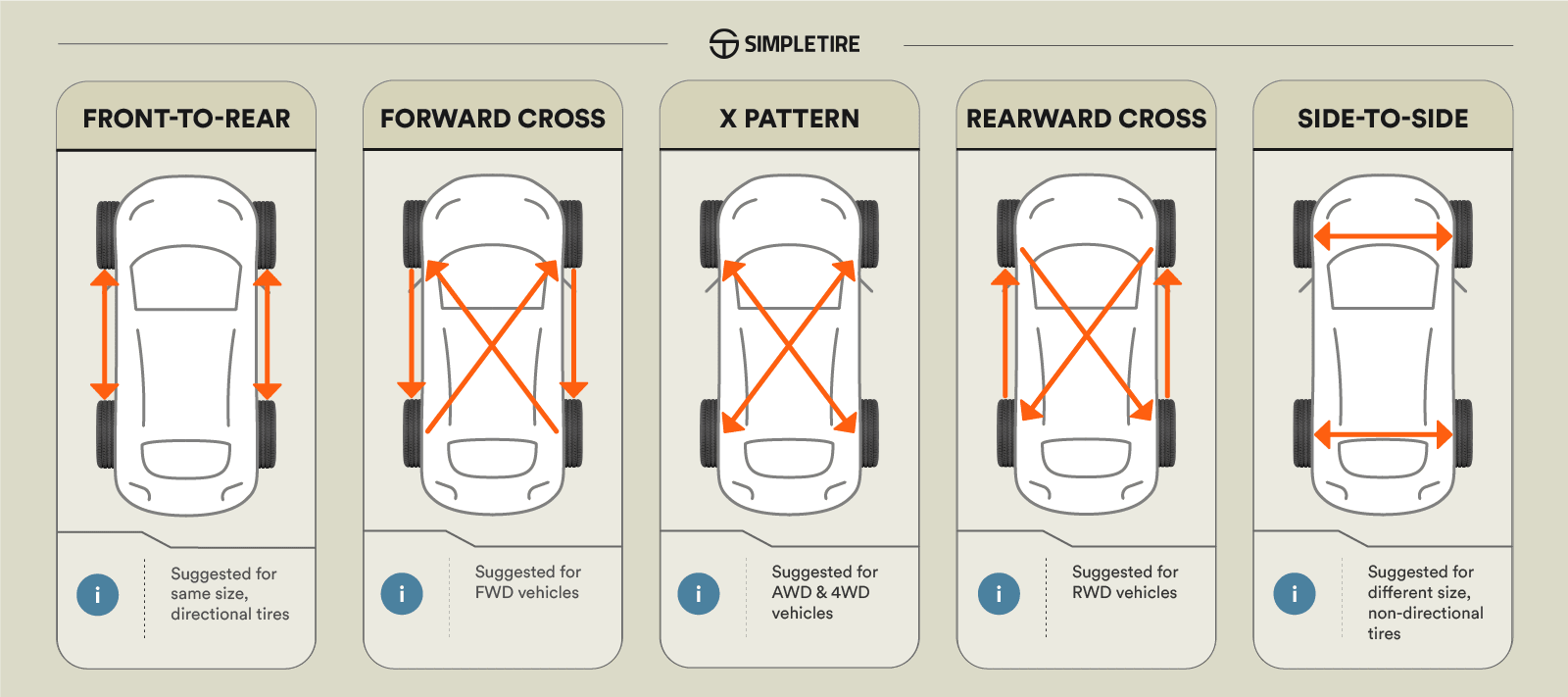
The best tire rotation pattern is the one that matches your tires, your vehicle, and your driving conditions. For many front-wheel drive cars with standard tires, the usual front-to-back and rear-cross pattern is the right choice. But there is no reason to guess.
Check these three things before rotating:
- Tire type — directional, non-directional, or asymmetric
- Wheel setup — same size or staggered
- Owner’s manual — the maker may recommend a specific pattern
If the manual gives a different pattern, follow the manual. Vehicle makers sometimes specify rotation methods that account for weight distribution, tire design, or performance tuning. That is especially important for newer cars and certain all-season or performance tires.
For most drivers, the goal is simple: keep all four tires wearing at a similar rate so the car stays safe and predictable for as long as possible.
Credit: simpletire.com
Final advice for better tire wear
A good Front Wheel Drive Tire Rotation Pattern is one of the easiest ways to protect your tires. But the best results come when rotation is part of a larger routine. Check pressure, inspect tread, watch for alignment problems, and rotate on time. These small habits work together.
If you remember only one thing, remember this: front tires do more work, so they need attention before they look “bad.” By the time uneven wear is obvious, some tire life is already gone. Regular rotation keeps the wear spread out and helps your tires last longer in real driving conditions.
For most front-wheel drive vehicles, the standard front-to-rear and rear-cross pattern is the smartest starting point. It is simple, effective, and easy to repeat. That consistency is what saves money and improves safety over time.
FAQs
1. What is the best Front Wheel Drive Tire Rotation Pattern?
For most front-wheel drive cars with non-directional tires, move the front tires straight to the rear on the same side, and cross the rear tires to the front. This helps balance the faster wear on the front axle.
2. How often should I rotate tires on a front-wheel drive car?
A good range is every 5,000 to 7,500 miles. If you drive in heavy traffic, on rough roads, or with frequent stop-and-go use, rotating closer to 5,000 miles is often better.
3. Can I rotate directional tires the same way?
No. Directional tires usually stay on the same side when moved front to rear. If you are not sure, check the sidewall for arrows or ask a tire shop before rotating.
4. Does tire rotation fix uneven wear?
It can slow or spread wear, but it does not fix the root cause. If wear is caused by bad alignment, low pressure, or suspension problems, those issues still need to be repaired.
5. Should I check tire pressure after rotating tires?
Yes. Tire pressure should be checked and set to the correct level after every rotation. This helps prevent new uneven wear and supports safer handling.