
When your car’s check engine light comes on and you find the code P0122 Throttle Position Sensor Low, it can feel confusing and stressful. This code means the engine control module (ECM) is seeing a voltage from the throttle position sensor (TPS) that is lower than expected. The TPS is important for your engine’s performance, so solving this problem quickly is a good idea. Whether you are a beginner or have some knowledge about cars, understanding the P0122 code can help you avoid costly mistakes and keep your car running smoothly.
What Does P0122 Throttle Position Sensor Low Mean?
The P0122 code is an OBD-II diagnostic trouble code. It tells you there is a problem with the voltage from the throttle position sensor circuit A. Your car’s computer expects the TPS to send a voltage between 0.2 and 4.5 volts. If the signal drops below about 0.2 volts, the ECM triggers code P0122.
The throttle position sensor is connected to your gas pedal and controls the engine’s air intake. When you press the pedal, the throttle opens, and the sensor tells the ECM how much air is coming in. If the ECM gets a low signal, it may think the throttle is closed even when it isn’t.
Symptoms Of P0122 Throttle Position Sensor Low
If your car has a P0122 code, you may notice several symptoms. These help you spot the problem early:
- Check engine light: The most obvious sign. The warning light will appear on your dashboard.
- Poor acceleration: Your car may feel slow or unresponsive when you press the gas pedal.
- Rough idle: The engine may shake or sound uneven while running.
- Stalling: The car may stall, especially when stopping or slowing down.
- Reduced fuel efficiency: You may notice you need to fill up your tank more often.
- Failing emissions test: The car might not pass inspection because of high emissions.
- Limp mode: Some cars enter a safety mode with limited power to prevent engine damage.
One non-obvious symptom is that cruise control may stop working, even if the check engine light is the only visible sign.
What Causes The P0122 Code?
There are several possible reasons for a P0122 code. Some are simple, while others need more detailed checks:
- Faulty throttle position sensor: The sensor itself may be damaged or worn out.
- Wiring issues: Broken, corroded, or loose wires can cause a weak signal.
- Bad electrical connections: Connectors may be dirty or not plugged in fully.
- Throttle body problems: Dirt, carbon build-up, or mechanical faults can affect the sensor.
- Faulty ECM: Rare, but the car’s computer itself could have a problem.
- Misadjusted sensor: On some cars, the TPS can be installed incorrectly.
Many beginners overlook checking the wiring and connectors, focusing only on the sensor. Yet, wiring faults are a common cause and much cheaper to fix.
How To Diagnose P0122 Throttle Position Sensor Low
Diagnosing P0122 is not just about changing the sensor. The best approach is step-by-step:
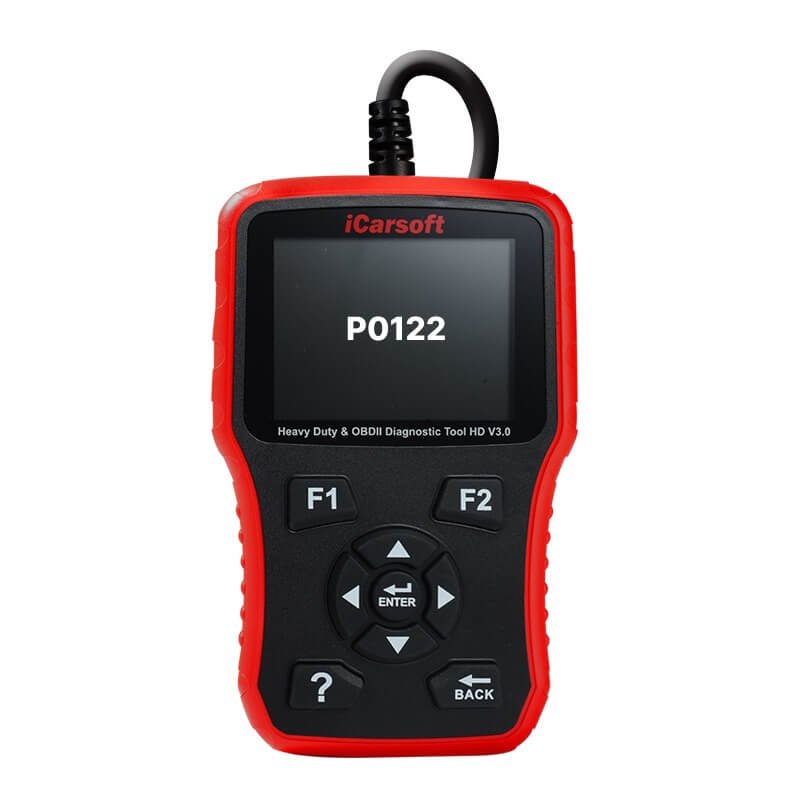
- Read the code: Use an OBD-II scanner to confirm P0122 and check for other codes.
- Visual inspection: Check the TPS and its wiring for damage, corrosion, or loose connections.
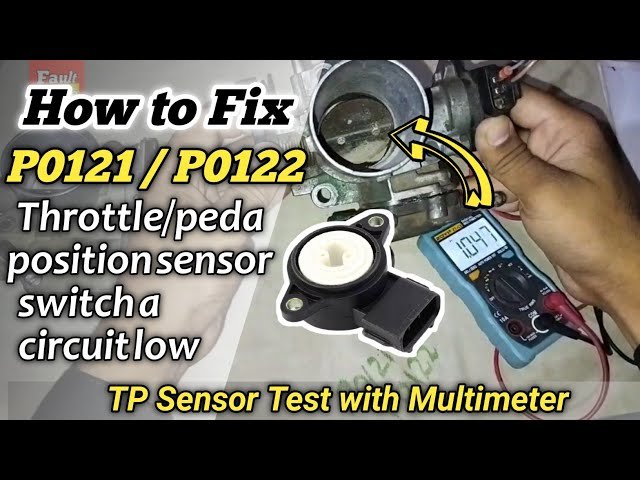
- Check voltage: Use a digital multimeter to test TPS voltage at the connector. With the ignition on (engine off), you should see a voltage between 0.2 and 1.0 volts at idle. Slowly open the throttle; voltage should rise smoothly to about 4.5 volts.
- Wiggle test: Gently move the wiring harness while monitoring voltage. If the reading jumps or drops, the wires may be broken inside the insulation.
- Test the sensor: Remove and test the TPS with a meter, or replace it with a known good one.
- ECM test: If everything else checks out, the ECM may be the issue, but this is rare.
Example: Diagnosing A Faulty Tps
Suppose your scanner shows P0122. You visually check the connector and spot green corrosion on the pins. Cleaning the connector and resetting the code fixes the problem. This simple step saves you from buying a new sensor.

Credit: www.carparts.com
How To Fix P0122 Throttle Position Sensor Low
Once you know the cause, you can fix P0122 with these steps:
- Repair or replace damaged wires: If wiring is broken or corroded, repair or replace it.
- Clean connectors: Use electrical contact cleaner on dirty or corroded connectors.
- Replace the TPS: If the sensor is faulty, install a new one. Most TPS units are inexpensive and easy to replace.
- Clean the throttle body: Remove carbon build-up that could affect the sensor’s readings.
- Reset the ECM: After repairs, clear the code with a scanner or by disconnecting the battery for a few minutes.
- Re-test: Drive the car and check that the code does not return.
Tips For Fixing P0122
- Always disconnect the battery before replacing electrical parts.
- If you replace the sensor, make sure it’s adjusted correctly. Some sensors need to be set to a specific position.
- Use only quality replacement parts to avoid repeated failures.
Throttle Position Sensor Replacement: Step-by-step
Replacing the throttle position sensor is a common fix for P0122. Here’s how to do it:
- Locate the TPS: Usually found on the throttle body.
- Disconnect the battery: Prevents accidental short circuits.
- Unplug the sensor: Remove the electrical connector.
- Remove the old sensor: Usually held by two screws.
- Install the new sensor: Line it up and tighten the screws.
- Reconnect the connector: Ensure a tight fit.
- Reconnect the battery: Restore power.
- Clear the code: Use a scanner or disconnect the battery for five minutes.
- Test drive: Make sure the code does not return and the car runs smoothly.
Credit: www.youtube.com
Data Table: Tps Voltage Ranges And Symptoms
Understanding the expected voltage range helps you diagnose the problem. Here’s a quick comparison:
| TPS Voltage (Idle) | TPS Voltage (Wide Open) | Possible Issue | Symptom |
|---|---|---|---|
| <0.2V | <1.0V | Short to Ground, Faulty TPS | P0122 Code, Poor Acceleration |
| 0.5-1.0V | 4.0-4.5V | Normal Operation | No Symptoms |
| >1.2V | >4.9V | Short to Power, Faulty TPS | P0123 Code, Hesitation |
Key Differences: P0122 Vs. Related Codes
Sometimes, you may see other codes related to the throttle position sensor. Here’s how they compare:
| Code | Description | Main Difference |
|---|---|---|
| P0120 | TPS Circuit Malfunction | General circuit fault, not just low voltage |
| P0121 | TPS Range/Performance | Signal out of expected range, not necessarily low |
| P0122 | TPS Low Input | Signal lower than expected |
| P0123 | TPS High Input | Signal higher than expected |
| P0222 | TPS B Low Input | Sensor B, not Sensor A |
Common Mistakes When Fixing P0122
- Replacing the sensor without checking wiring: Many people buy a new TPS right away, but the real problem is often a loose or corroded connector.
- Forgetting to clear the code: After repairs, always use a scanner to clear the code. Sometimes, the code will not go away on its own.
- Not adjusting the new sensor: Some TPS units need to be set in the correct position. If not, you could get another code or poor performance.
- Ignoring related codes: If you see more than one code, address them all. They may point to the root cause.
Real-world Example: How One Driver Fixed P0122
Maria’s 2012 Ford Focus started stalling at stop lights. The check engine light came on, and her mechanic found code P0122. They checked the sensor and found the connector loose. After tightening it and cleaning the pins, the car ran perfectly again. According to the U.S. Environmental Protection Agency, vehicle emissions standards and onboard diagnostic systems are designed to identify problems that can increase pollution.
No new parts were needed. This example shows the value of checking simple things before replacing expensive parts.
Prevention Tips For Throttle Position Sensor Issues
You can avoid many TPS problems by following a few simple steps:
- Regularly inspect wiring: Check for loose or damaged wires during oil changes.
- Keep the throttle body clean: Carbon build-up can cause sensor errors.
- Use quality fuel: Poor fuel can increase carbon deposits.
- Fix check engine lights early: Small problems can grow into bigger ones.
A key insight is that many TPS problems are caused by issues outside the sensor itself. Often, simple maintenance is enough to prevent trouble.
When To See A Professional
Some repairs are best left to trained mechanics. Seek help if:
- The code returns after you replace the sensor and repair wiring.
- The throttle body is hard to reach or requires special tools.
- You are not comfortable using a multimeter.
A certified technician can use advanced diagnostic tools to find hidden problems.
Cost To Fix P0122 Throttle Position Sensor Low
Repair costs can vary:
- DIY repair: Cleaning connectors or replacing the sensor yourself may cost $20–$60 for parts.
- Professional repair: Labor and diagnostics at a shop may add $80–$150.
- Wiring repairs: If wires must be replaced, the cost can go up, especially for hard-to-reach areas.
Most fixes are affordable if caught early. Ignoring the problem can lead to bigger issues, like catalytic converter damage, which is much more expensive.
How Long Can You Drive With A P0122 Code?
Driving with a P0122 code is risky. Your car may run poorly or stall, especially in traffic. Long-term driving can damage other engine parts. It’s best to fix the problem as soon as possible.
Credit: www.ziptuning.com
External Resource
For deeper technical details on throttle position sensors, see the Throttle Position Sensor page on Wikipedia.
Frequently Asked Questions
What Happens If I Ignore The P0122 Code?
Ignoring P0122 can lead to poor performance, unsafe driving, and costly engine damage. The car may stall or run roughly, and you might fail emissions tests.
Can I Clean The Throttle Position Sensor?
You can clean the throttle body, but the sensor itself is usually sealed. Cleaning the connector and throttle plate may solve some issues, but if the sensor is faulty, replacement is best.
Is It Safe To Drive With A P0122 Code?
Driving short distances to a repair shop is usually safe, but avoid long trips. The engine may lose power or stall at any time.
Do I Need Special Tools To Fix P0122?
A digital multimeter and a basic socket set are usually enough. Some cars may require security Torx bits or a scan tool to clear the code.
Can A Bad Battery Cause A P0122 Code?
A weak battery can cause low voltage issues, but it’s rare for it to cause P0122 directly. Always check battery health if you see multiple sensor codes.
Getting a P0122 code can be annoying, but with a careful approach, you can solve it without stress. Focus on checking connectors and wiring before replacing parts, and you’ll often fix the problem for little cost. A bit of patience and the right steps can keep your car running smoothly and reliably.