
As a general rule, you should get a wheel alignment every two to three years or every 20,000 to 30,000 miles. However, it’s crucial to get an alignment check immediately if you notice uneven tire wear, your car pulls to one side, or after hitting a major pothole or curb. Paying attention to your vehicle’s behavior is just as important as following a maintenance schedule.
- General Schedule: Every 2-3 years or 20,000-30,000 miles.
- Key Symptoms: Vehicle pulling, crooked steering wheel, uneven tire wear.
- Immediate Triggers: After hitting a pothole, curb, or getting into a minor accident.
- Related Maintenance: Always check alignment when installing new tires or replacing suspension parts.
What Is a Wheel Alignment and Why Is It Crucial for Your Car?
A wheel alignment, sometimes called a tire alignment, doesn’t involve adjusting the tires or wheels themselves. Instead, it’s the process of adjusting your vehicle’s suspension system—the components that connect your car to its wheels. The goal is to ensure the wheels are angled correctly relative to each other and to the road surface.
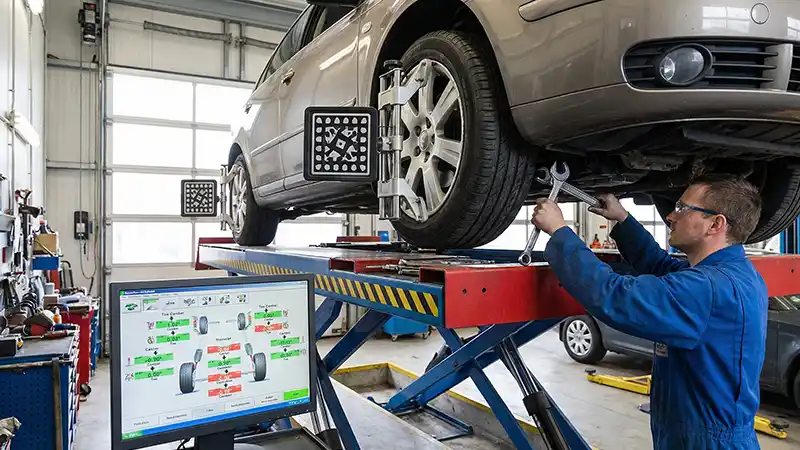
Proper alignment involves fine-tuning three key angles:
- Toe: This is the direction your tires point relative to the centerline of the vehicle when viewed from above. Think of it like looking down at your own feet. If they point inward, it’s called toe-in; if they point outward, it’s toe-out.
- Camber: This is the inward or outward tilt of the top of the tire when viewed from the front of the car. Too much inward tilt (negative camber) or outward tilt (positive camber) can cause premature tire wear and handling issues.
- Caster: This angle refers to the forward or backward tilt of the steering axis when viewed from the side. Caster helps with steering stability and cornering, ensuring your steering wheel returns to the center after a turn.
These angles are calibrated to precise manufacturer specifications. When they are out of adjustment, it can negatively impact your vehicle’s handling, safety, and the lifespan of your tires.
How often should I get an alignment?
While the common recommendation is a good starting point, the ideal frequency for a wheel alignment depends on several factors, including your driving habits, road conditions, and your vehicle’s age. Let’s break down the different guidelines to follow.
The General Maintenance Schedule
For most vehicles under normal driving conditions, getting an alignment check every two to three years or every 20,000 to 30,000 miles is a sound preventative measure. This proactive approach helps catch minor misalignments before they lead to significant tire wear or handling problems. Many drivers choose to have their alignment checked when they rotate their tires.
Consult Your Owner’s Manual
Your vehicle’s manufacturer provides the most accurate maintenance schedule. Always refer to your owner’s manual for specific recommendations. Some high-performance vehicles or those with specialized suspension systems may require more frequent checks.
Event-Based Alignment Checks
More important than any schedule are the events that can instantly knock your alignment out of specification. You should always have your alignment checked after certain occurrences, regardless of when it was last done. These events are covered in detail below.
Symptom-Based Alignment Checks
Finally, your car is the best indicator. If you notice any of the warning signs of a bad alignment, such as the vehicle pulling to one side, you should have it inspected by a professional immediately. Don’t wait for your next scheduled service.
7 Telltale Signs Your Car Needs an Alignment Immediately
Your vehicle will often give you clear signals when its alignment is off. Ignoring these signs can lead to more significant issues and compromise your safety on the road. Be on the lookout for these common symptoms.
- Vehicle Pulling to the Left or Right: When driving on a straight, level road, you should be able to briefly let go of the steering wheel without the car veering off course. If your car consistently pulls to one side, it’s a classic sign of misalignment.
- Uneven or Rapid Tire Wear: This is one of the most common indicators. Inspect your tires regularly. If you see that the inside or outside edge of a tire is wearing down much faster than the rest of the tread, a bad alignment is the likely culprit. You might also notice feathering, where the tread blocks are worn smooth on one side and sharp on the other.
- Crooked Steering Wheel: When you are driving straight, your steering wheel should be centered and level. If you have to hold the wheel at an angle to keep the car moving straight, your alignment is off.
- Squealing Tires: If your tires squeal or screech during routine turns at normal speeds, it can be a sign that they are being dragged sideways instead of rolling smoothly. This is often caused by a poor toe angle.
- Vibrations in the Steering Wheel: While vibrations can also be caused by unbalanced tires, a bad alignment can contribute to this issue. You might feel a shimmy or vibration that gets worse as you increase your speed.
- Poor Steering Response: A properly aligned car feels tight and responsive. If the steering feels loose, sloppy, or doesn’t return to center easily after a turn, it could be related to the caster or other alignment angles.
- Audible Distress: You may hear creaking, knocking, or groaning sounds, especially when turning at low speeds. While this can point to other suspension issues, these problems often go hand-in-hand with misalignment.
Key Events That Warrant an Immediate Alignment Check
Certain impacts and maintenance procedures can instantly ruin a perfect alignment. After any of the following events, it’s wise to schedule an inspection.
Hitting a Pothole or Curb
A significant jolt from hitting a deep pothole, running over a curb, or striking road debris can be enough to bend suspension components and throw your alignment out of whack. Even if you don’t notice an immediate change in handling, the impact can cause a slow-developing issue.
Minor Accidents or Collisions
Any collision, even a low-speed fender bender, can affect the suspension and steering systems. After any accident, an alignment check should be part of the repair process to ensure the vehicle is safe to drive.
Installing New Tires
Getting an alignment when you buy new tires is a smart investment. It ensures your vehicle’s suspension is set correctly, preventing the new tires from wearing out prematurely due to a pre-existing issue. It protects your purchase and maximizes tire life.
Replacing Suspension or Steering Components
If you replace parts like struts, shocks, ball joints, tie rods, or control arms, a wheel alignment is almost always required. These components are integral to the suspension geometry, and replacing them will alter the current angles.
Understanding the Wheel Alignment Process: What to Expect
A wheel alignment is a precise procedure that uses sophisticated equipment. When you take your car to a qualified auto shop, a technician will typically follow these steps:
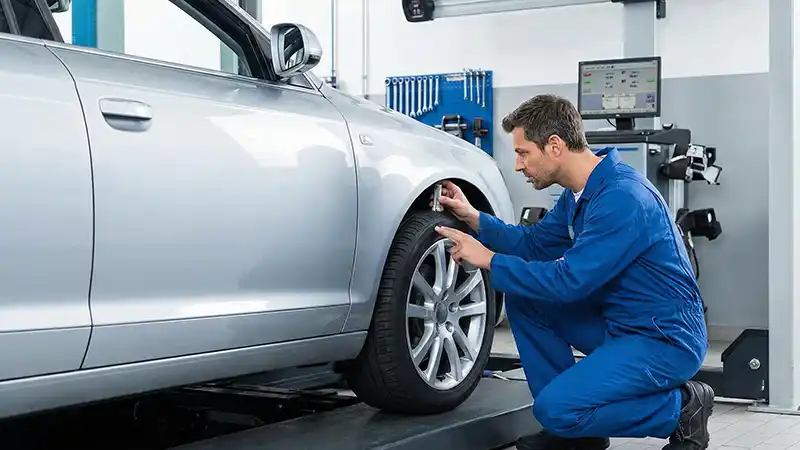
- Initial Inspection: The technician will first inspect the tires for wear patterns and check the suspension and steering components for any damage or looseness. Worn-out parts must be replaced before a proper alignment can be performed.
- Mounting the Vehicle: Your car is driven onto an alignment rack, which lifts the vehicle to allow access to the suspension.
- Attaching Sensors: Highly sensitive sensors or targets are attached to each of the four wheels. These devices communicate with a central computer.
- Measurement and Analysis: The computer, which contains the manufacturer’s alignment specifications for your specific vehicle model, measures the current angles of your wheels and compares them to the ideal settings.
- Adjustment: The technician then makes precise adjustments to the suspension components to bring the toe, camber, and caster angles back into the manufacturer’s recommended range.
- Final Report: Once the alignment is complete, you will often receive a printout showing the before-and-after measurements, confirming that your vehicle’s alignment is now within specification.
The Major Benefits of a Proper Wheel Alignment
Keeping your vehicle properly aligned is not just about maintenance; it provides tangible benefits for your wallet and your safety.
Improved Vehicle Safety and Handling
A correctly aligned car is more stable and predictable. It tracks straight, responds accurately to steering inputs, and provides a safer driving experience, especially in emergency maneuvers or adverse weather conditions.
Extended Tire Lifespan
Misalignment is a leading cause of premature tire wear. By ensuring your wheels are angled correctly, you guarantee that the tires wear evenly across the tread, maximizing their lifespan and saving you from replacing them sooner than necessary.
Better Fuel Economy
When your wheels are fighting each other due to misalignment, your engine has to work harder to move the car forward. This increases rolling resistance and, consequently, fuel consumption. A proper alignment can improve your gas mileage.
Smoother Driving Experience
A well-aligned vehicle provides a more comfortable and pleasant ride. It eliminates annoying pulls, reduces steering wheel vibrations, and makes driving less fatiguing, particularly on long trips.
Factors Influencing Wheel Alignment Service
Not all alignment services are the same. Several factors can determine the type of service your vehicle needs and its complexity.
Two-Wheel vs. Four-Wheel Alignment
A two-wheel alignment (or front-end alignment) adjusts only the front wheels. This is suitable for some front-wheel-drive vehicles with a solid rear axle. A four-wheel alignment adjusts all four wheels and is necessary for all-wheel-drive, four-wheel-drive, and many modern front-wheel-drive vehicles with adjustable rear suspensions.
Advanced Driver-Assistance Systems (ADAS)
Many modern cars are equipped with ADAS features like lane-keeping assist and adaptive cruise control. These systems rely on cameras and sensors that are often linked to the vehicle’s steering and alignment. After an alignment, these systems may need to be recalibrated, which is a more involved process.
Condition of Suspension Components
An alignment can only be performed correctly if the suspension and steering parts are in good condition. If a technician finds worn ball joints, tie rods, or bushings, these parts must be replaced before the alignment can be completed. This adds to the overall scope of the repair.
Frequently Asked Questions About Wheel Alignments
How do I know if I need an alignment or my tires balanced?
A bad alignment typically causes the car to pull to one side and results in uneven tire wear. Unbalanced tires, on the other hand, usually cause vibrations or shaking in the steering wheel or seat, which often becomes more noticeable at higher speeds.
Can I drive my car with a bad alignment?
While you can technically drive a car with a minor misalignment, it is not recommended. It compromises safety, reduces handling precision, and will cause accelerated wear on your tires and suspension components, leading to more extensive repairs down the road.
Does getting new tires mean I need an alignment?
It is highly recommended to get a wheel alignment when you install new tires. An underlying alignment issue is often the cause of the old tires wearing out. Aligning the vehicle ensures your new tires start with the best possible conditions to wear evenly and last as long as possible.
How long does a typical wheel alignment take?
A standard four-wheel alignment on a vehicle with no major issues typically takes about an hour. If suspension parts need to be replaced or if the vehicle requires ADAS recalibration, the process can take longer.
What’s the difference between a two-wheel and a four-wheel alignment?
A two-wheel alignment only adjusts the angles of the front wheels. A four-wheel alignment adjusts the angles on all four wheels, which is essential for vehicles with independent rear suspension and all-wheel-drive systems to ensure all wheels are working together correctly.
After hitting a curb, should I get an alignment?
Yes, absolutely. Hitting a curb, even at low speed, can easily knock your suspension out of alignment. It’s best to have it checked by a professional to prevent uneven tire wear and potential handling problems.
Conclusion
Adhering to a regular maintenance schedule of getting an alignment check every two to three years is a great practice, but it’s even more important to listen to your car. Telltale signs like the vehicle pulling, a crooked steering wheel, or uneven tire wear are clear indicators that an immediate inspection is needed. Proper alignment is fundamental to your vehicle’s safety, efficiency, and longevity. If you notice any of these symptoms or have had a recent impact, consult a trusted mechanic to ensure your car remains in top condition.
{“@context”:”https://schema.org”,”@type”:”Article”,”headline”:”How Often Should I Get An Alignment”,”mainEntityOfPage”:”https://autofixnotes.com/?p=1094″,”datePublished”:”2025-12-11T05:03:21+00:00″,”dateModified”:”2025-12-11T05:03:21+00:00″}