
As a general rule, you should rotate your tires every 5,000 to 7,500 miles. However, this interval can vary based on your vehicle’s drivetrain, tire type, and your personal driving habits. The most accurate recommendation for your specific car can always be found in your owner’s manual.
- Even Tread Wear: Rotation ensures all four tires wear down at a similar rate.
- Longer Tire Life: Proper rotation can significantly extend the lifespan of your tires.
- Improved Safety: Balanced tread depth provides more predictable handling and traction.
- Drivetrain Health: Crucial for AWD systems, which require all tires to be a similar diameter.
- Warranty Compliance: Most tire manufacturers require regular rotations to keep the treadwear warranty valid.
Why Is Tire Rotation a Non-Negotiable Part of Car Maintenance?
Tire rotation is a fundamental aspect of vehicle upkeep that directly impacts both safety and performance. It involves systematically moving each tire to a different position on the vehicle. This simple procedure is essential because tires in different positions wear at different rates.

For example, on a front-wheel-drive car, the front tires handle the forces of steering, acceleration, and a majority of the braking. They also support the weight of the engine and transaxle. Consequently, they wear down much faster than the rear tires. By rotating them, you distribute this wear more evenly across all four tires, preventing one pair from becoming unsafe while the others still have plenty of life left.
The core benefits of consistent tire rotation include maximizing tire life, ensuring predictable vehicle handling, and maintaining optimal traction in various road conditions. It’s a low-effort, high-reward task that protects your investment in your tires and contributes to a safer driving experience.
How Often Should I Rotate My Tires? The General Rule
The most common recommendation for how often you should rotate your tires is every 5,000 to 7,500 miles. For many drivers, this interval conveniently aligns with their vehicle’s oil change schedule, making it easy to remember. However, this is just a guideline, and the ideal frequency depends heavily on your vehicle’s drivetrain.
Front-Wheel Drive (FWD) Vehicles
FWD cars put the most stress on the front tires. Since these tires are responsible for both steering and powering the vehicle, they wear significantly faster. The recommended rotation interval is typically in the 5,000 to 7,500-mile range. A common rotation pattern is the forward cross, where front tires move straight back and rear tires move to the opposite sides in the front.
Rear-Wheel Drive (RWD) Vehicles
In RWD vehicles, the wear pattern is more balanced, but the rear tires, which deliver power, often wear faster than the fronts. The front tires handle the bulk of the steering forces. A rearward cross pattern is often recommended, where the rear tires move straight forward and the front tires move to the opposite sides of the rear axle.
All-Wheel Drive (AWD) & 4×4 Vehicles
For AWD and 4×4 vehicles, regular tire rotation is critically important. These systems are designed to work with wheels that are all spinning at the same speed. A significant difference in tread depth (and therefore, tire diameter) between the front and rear tires can strain the drivetrain, potentially leading to expensive damage. Because of this, many manufacturers recommend a more frequent rotation interval, often between 3,000 and 5,000 miles.
Electric Vehicles (EVs)
Electric vehicles present unique challenges for tires. The instant torque delivered by electric motors can cause more rapid tire wear. Additionally, the heavy battery packs increase the overall vehicle weight. For these reasons, EV owners should adhere strictly to the manufacturer’s rotation schedule, which may be more frequent than for a comparable gasoline-powered car.
Key Factors That Influence Rotation Frequency
Beyond your vehicle’s drivetrain, several other factors can affect how quickly your tires wear and how often they should be rotated.
- Driving Habits: Aggressive driving with rapid acceleration, hard braking, and sharp cornering puts immense stress on your tires, leading to faster wear. A more conservative driving style will extend the time between rotations.
- Road Conditions: Driving frequently on poorly maintained roads, gravel, or in areas with many potholes can accelerate uneven wear. Consistent highway driving at steady speeds is generally easier on tires than stop-and-go city traffic.
- Vehicle Load: Regularly carrying heavy cargo or towing a trailer increases the load on your tires, particularly the rear ones. If you often use your vehicle for heavy-duty tasks, you may need to rotate your tires more frequently.
- Tire Type: High-performance or summer tires are often made from softer rubber compounds that provide excellent grip but wear out faster. In contrast, hard-compound all-season or touring tires are designed for longevity and may not require rotation as urgently.
5 Telltale Signs You Need a Tire Rotation Now
Your vehicle will often give you clear signals that its tires are due for a rotation. Ignoring these signs can lead to premature tire replacement and potential safety issues.
- Uneven Tread Wear: This is the most obvious sign. Look for wear patterns like ‘feathering’ (one side of a tread block is worn more than the other) or ‘cupping’ (scalloped dips in the tread). You may also notice the tread on your front tires is visibly lower than on your rear tires.
- Vehicle Vibration: If you feel a noticeable vibration through the steering wheel or the seat, especially at speeds above 45 mph, it could be a sign of uneven tire wear. While this can also indicate a tire balancing issue, it often points to the need for a rotation.
- Pressure Loss in One Tire: While not always related, a tire that consistently loses pressure faster than the others might be bearing an uneven load, which a rotation can help correct.
- Poor Handling: When your tires are unevenly worn, the vehicle’s handling can become less responsive. You might notice a change in cornering performance or a general feeling of instability.
- Audible Road Noise: A humming or whirring sound that changes with speed can sometimes be caused by irregular tire wear. As the uneven tread pattern makes contact with the pavement, it creates a distinct noise.
Understanding the Different Tire Rotation Patterns
The correct rotation pattern ensures that each tire spends time at every position on the vehicle. Always check your owner’s manual for the specific pattern recommended for your car.
- Rearward Cross: The most common pattern for RWD, AWD, and 4×4 vehicles. The rear tires are moved to the front on the same side, while the front tires are moved to the opposite sides at the rear.
- Forward Cross: Typically used for FWD vehicles. The front tires are moved straight to the rear, while the rear tires are moved to the opposite sides at the front.
- X-Pattern: A simple pattern where all tires are moved diagonally. This is a common alternative for FWD and RWD cars.
- Side-to-Side: This pattern is used for vehicles with different-sized tires on the front and rear axles or for directional tires. The tires are simply swapped from one side to the other on the same axle. Directional tires must be dismounted and remounted to be moved to the opposite side.
- Five-Tire Rotation: If you have a full-size matching spare tire, including it in the rotation pattern ensures all five tires wear evenly. This extends the life of the entire set and ensures your spare is always in good condition.
What to Expect from a Professional Tire Rotation Service
When you take your vehicle to a professional for a tire rotation, the service typically involves more than just swapping the wheels. A technician will perform a comprehensive service to ensure everything is in top condition.
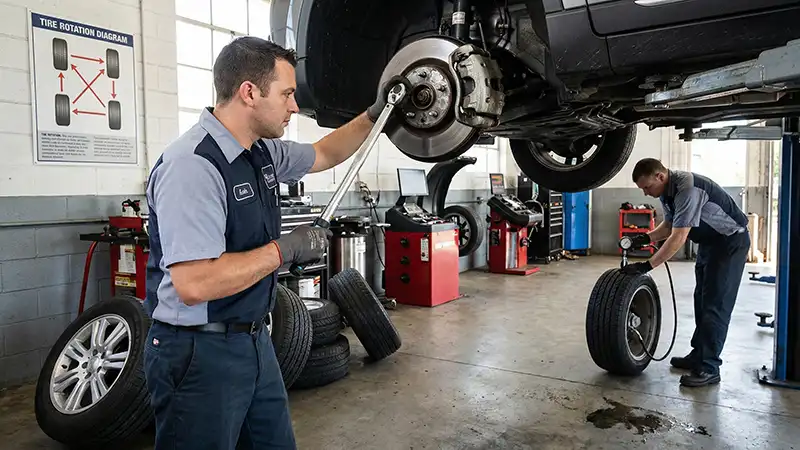
The process usually includes removing all four wheels, inspecting the tires for any damage or unusual wear patterns, and checking the tread depth. They will also inspect your brakes, which are easily visible once the wheels are off. After moving the tires to their new positions according to the correct pattern, they will properly torque the lug nuts to the manufacturer’s specifications. Many services also include adjusting the tire pressure to the recommended level. Some may also suggest a wheel balancing service to ensure a smooth ride.
What Happens If You Never Rotate Your Tires?
Neglecting tire rotation can lead to a cascade of negative consequences that affect your safety and your wallet.
- Premature Tire Wear: The most immediate result is that your front or rear tires will wear out much faster than the others, forcing you to replace a full set of four tires when two might still have significant life left.
- Reduced Safety: As tires wear unevenly, their ability to grip the road diminishes. This can lead to poor traction in wet or snowy conditions, increased braking distances, and a higher risk of hydroplaning or blowouts.
- Compromised Handling: Uneven wear disrupts the vehicle’s balance, leading to vibrations, pulling to one side, and less responsive steering.
- Drivetrain Damage: On AWD vehicles, failing to rotate tires can cause significant differences in tire circumference, which puts constant strain on the center differential and other drivetrain components, potentially leading to catastrophic failure.
- Voided Warranty: Nearly all tire manufacturers require proof of regular rotations to honor their tread life warranties. If you can’t show that the tires were properly maintained, your claim will likely be denied.
Can I Rotate My Own Tires? DIY vs. Professional Service
Rotating your own tires is a manageable task for those with the right tools and a focus on safety. However, it’s important to weigh the pros and cons against having it done professionally.
The DIY Approach
To perform a rotation at home, you will need a reliable car jack, at least two sturdy jack stands, and a lug wrench that fits your vehicle’s lug nuts. The most critical aspect of a DIY rotation is safety. Never work on a vehicle supported only by a jack; always use jack stands placed at the vehicle’s designated support points. You must also know the correct rotation pattern and the proper torque specification for your lug nuts to tighten them securely without over-tightening.
The Professional Advantage
While a DIY rotation is possible, a professional service offers several benefits. Auto shops use hydraulic lifts, which are safer and more efficient than a floor jack. Technicians have access to pneumatic tools and calibrated torque wrenches to ensure every lug nut is perfectly tightened. Most importantly, a professional can also perform a wheel balancing service at the same time, which is essential for eliminating vibrations and requires specialized machinery.
Frequently Asked Questions About Tire Rotation
- Does the tire rotation frequency change for an AWD vehicle?
- Yes, AWD vehicles often require more frequent rotations, typically every 3,000 to 5,000 miles. Consistent tread depth on all four tires is crucial to prevent strain on the complex all-wheel-drive system. Always check your owner’s manual for the exact interval.
- Is it okay to just rotate my tires during my regular oil change?
- Aligning tire rotations with oil changes is a common and convenient practice, as their service intervals are often similar. However, if your oil change interval is longer, such as 10,000 miles, you should schedule a separate tire rotation in between to prevent excessive uneven wear.
- What is the main consequence of not rotating tires often enough?
- The primary consequence is premature and uneven tire wear, which significantly shortens the life of your tires. This leads to reduced vehicle safety due to decreased traction and handling, and can potentially void your tire manufacturer’s treadwear warranty.
- Do new cars need their tires rotated?
- Absolutely. Tire rotation is important from the very first service interval. Starting the practice early establishes an even wear pattern from the beginning, ensuring you get the maximum life and performance out of the original set of tires that came with your new vehicle.
- How do I know which tire rotation pattern to use?
- The correct pattern depends on your vehicle’s drivetrain (FWD, RWD, AWD) and tire type (directional or non-directional). Your vehicle’s owner’s manual is the best source for this information, as it will specify the manufacturer’s recommended rotation pattern.
- Can I just rotate the front tires to the back?
- Simply swapping the front and rear tires on the same side is only appropriate for vehicles with directional tires that cannot be moved to the other side. For most cars with non-directional tires, a cross-rotation pattern is recommended for more even wear.
Conclusion
Rotating your tires every 5,000 to 7,500 miles is one of the most effective ways to extend their life, improve your vehicle’s handling, and ensure your safety on the road. By understanding your vehicle’s specific needs and paying attention to signs of uneven wear, you can make this simple maintenance task a cornerstone of responsible car ownership. If you’re unsure about the process or notice any unusual vibrations, consult a trusted mechanic to have your tires inspected and serviced professionally.
{“@context”:”https://schema.org”,”@type”:”Article”,”headline”:”How Often Should I Rotate My Tires”,”mainEntityOfPage”:”https://autofixnotes.com/?p=1091″,”datePublished”:”2025-12-10T21:02:00+00:00″,”dateModified”:”2025-12-10T21:02:00+00:00″}