
When a car will not crank and will not start, the problem often feels bigger than it really is. The engine is silent, the key turns, and nothing useful happens. In many cases, this is not a major engine failure. It is usually an electrical, battery, starter, or safety switch issue that can be found with a calm, step-by-step check.
The good news is that No Crank No Start Diagnosis does not have to be slow or confusing. If you know what to look for in the right order, you can cut through the guesswork and find the cause much faster. The key is to separate a battery problem from a starter problem, and a starter problem from a control or security problem.
This guide shows a simple way to trace the fault, test the most common parts, and avoid the mistakes that waste time and money. You will also learn a few small clues that many beginners miss, such as the meaning of clicking sounds, dim lights, and whether the dash lights behave normally when you turn the key.
Start with the symptom, not the guess
The phrase “no crank no start” sounds simple, but it can point to very different faults. “No crank” means the engine does not turn over when you try to start it. “No start” means the engine may crank but still not run. When both happen together, the first goal is to find out whether the starter motor is being asked to work at all.
Before touching tools, take 30 seconds to observe the car. These quick clues matter more than many people think:
- Do the dash lights turn on?
- Do the headlights look bright or weak?
- Do you hear one click, several clicks, or total silence?
- Does the starter work sometimes and fail other times?
- Does the problem change when the gear shifter is moved?
Those clues help you decide where to begin. A weak battery often gives slow lights and rapid clicking. A bad starter may give one solid click or no movement at all. A neutral safety switch issue may show up only in Park or only in Neutral. These patterns are useful because they save you from replacing parts at random.
Check the battery first, but check it the right way
The battery is the most common reason for a no crank problem. But many people make one bad assumption: if the dash lights come on, the battery must be fine. That is not true. A battery can have enough power for lights and still fail under the heavy load needed to crank the engine.
First, inspect the battery terminals. Look for white or green corrosion, loose clamps, or damaged cables. A battery with dirty or loose terminals can act dead even when the battery itself is still usable. Try to move each terminal by hand. If it moves, it is too loose.
If you have a multimeter, check battery voltage with the car off. A healthy, fully charged battery should usually read about 12.6 volts. Around 12.2 volts suggests it is weak. Below 12.0 volts is a serious warning sign. But even this does not tell the full story. A battery can show decent voltage and still collapse under load.
That is why load matters. Turn the key to start and watch the lights. If they drop sharply or go dark, the battery may be too weak, or the battery cables may have high resistance. A jump start can help confirm this. If the car starts with a jump, the battery, cables, or charging system deserve close attention.
Non-obvious insight: A bad ground cable can mimic a dead battery almost perfectly. If the negative cable connection to the body or engine is weak, the car may show normal voltage but fail to crank. Many beginners replace the battery first and still keep the same problem.
Simple battery checks
- Check for corrosion on both terminals.
- Make sure the clamps are tight.
- Test voltage with the engine off.
- Watch the lights while turning the key.
- Try a jump start if the battery seems weak.
Listen carefully to what the car is telling you
The sound the car makes during a no crank event is a major clue. Different sounds often point to different faults. You do not need advanced tools to use this information well.
| Sound or symptom | Likely area | What it may mean |
|---|---|---|
| Total silence | Battery, ignition switch, relay, security system | No signal is reaching the starter circuit |
| Single click | Starter, relay, battery cables | Starter may be receiving power but not turning |
| Rapid clicking | Battery, weak connection | Not enough power to engage the starter |
| Slow crank | Battery, starter, engine load | Starter is struggling to turn the engine |
| Crank but no start | Fuel, spark, sensor, security system | Engine turns, but combustion does not happen |
One important detail: a clicking sound does not always mean the starter is bad. Sometimes the starter relay clicks because it is receiving a signal, but the main power feed is weak. This is why it helps to test the battery and cables before replacing the starter.
Test the starter circuit, not just the starter motor
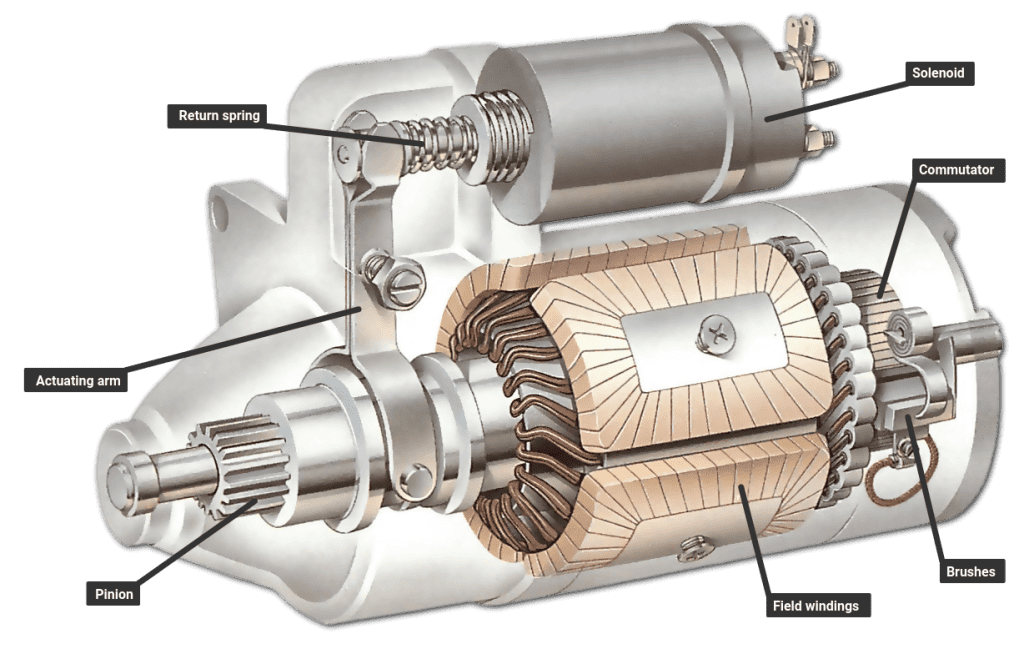
Many people think a no crank problem means the starter is bad. Sometimes that is true, but often the starter is only the final part in a longer chain. The starter needs battery power, a good ground, and a command signal from the ignition switch or relay. If any part of that chain fails, the starter may stay silent.
Try this simple question: Does the starter receive power when you turn the key? If not, the fault may be in the relay, fuse, ignition switch, clutch switch, neutral safety switch, or wiring. If yes, but the starter does not turn, the starter itself may be failing.
On many vehicles, you can listen or feel for the starter relay. When a helper turns the key to start, the relay may click in the fuse box. If it clicks but the starter does nothing, the relay may be working while the high-current side is failing.
Non-obvious insight: Heat can expose a weak starter. A starter that works cold may fail after the engine is warm. The reason is simple: worn internal parts and heat-related resistance make the starter work harder. If the problem appears more often after driving, do not ignore that clue.

Credit: elreg.com
Starter circuit checks that matter most
- Check the main battery cable to the starter.
- Check the ground cable from battery to engine/body.
- Inspect starter relay and related fuses.
- See whether the starter gets a start signal.
- Test for starter operation under load.
Do not forget the safety switches
Modern cars often block starting for safety. This is a good thing, but it can confuse diagnosis. If the car thinks the transmission is not in Park or Neutral, or the clutch is not pressed, it may refuse to crank.
For automatic cars, the neutral safety switch or transmission range sensor may be the issue. Try starting in Neutral instead of Park. Move the shifter firmly and hold the key in the start position. If it suddenly starts, the switch or shifter adjustment may be the problem.
For manual cars, the clutch pedal switch can fail or fall out of adjustment. Press the clutch fully and try again. Sometimes the pedal switch only works when the pedal is pushed all the way to the floor. If the car starts only with extra pedal pressure, the switch or its mount may be worn.
These parts are easy to overlook because they do not seem like “starting” parts. But they can block the entire starter circuit.
Check the ignition switch and start relay
If the battery and starter seem okay, the next step is to see whether the car is sending a start command. The ignition switch, starter relay, and related wiring act like the bridge between your key and the starter motor.
When you turn the key to the start position, the switch should send power through the relay and then to the starter solenoid. If the switch is worn, the relay may never get the signal. If the relay is faulty, the signal may stop there. If the wiring is damaged, the signal may be lost before reaching the starter.
One useful test is to swap the starter relay with another relay of the same type in the fuse box, if the design allows it. Only do this if the relays match exactly. If the car starts after the swap, you may have found the fault.
Another clue is whether the radio, dash, or accessories act strangely when the key is turned. A failing ignition switch may cause unrelated electrical behavior, such as flickering accessories or no power in the start position.
Look at the engine ground and power connections
Ground issues cause more trouble than many drivers realize. A car can have a good battery, a good starter, and still fail to crank because the electricity cannot return properly through the ground path.
Check the negative battery cable where it connects to the body and engine. Look for rust, looseness, broken strands, or oil contamination. Also inspect the positive cable to the starter. A cable can look fine outside and still be damaged inside.
Here is a simple test that often helps: try a jump cable from the negative battery post directly to a clean metal part of the engine. If the car cranks better, the ground path is weak. This does not fix the problem, but it confirms where to look next.
Small corrosion spots can cause big voltage loss. That is why cleaning and tightening terminals can solve a problem that looked serious at first.
Credit: 8020automotive.com
Separate no crank from crank but no start
People often mix these two problems together, but they are not the same. This matters because the test path is different.
If the engine does not crank, focus on battery power, cables, starter, relays, ignition switch, and safety switches. If the engine cranks normally but does not start, move to fuel, spark, injector pulse, crank sensor, and anti-theft issues.
When the engine cranks but will not start, listen for the fuel pump prime when the key is turned on. Check for spark if you have the right tools. Make sure the security light is not flashing in a warning pattern. These are not starter problems, so replacing the starter will not help.
This is one of the most common beginner mistakes: using “no crank no start” as if it always means one problem. In reality, you must first ask whether the engine is cranking at all.
Use a logical order so you do not waste money
The fastest way to solve a starting problem is to test in the right order. Do not begin with the most expensive part. Start with the easiest checks that also have the highest chance of finding the fault.
- Check battery condition and terminal tightness.
- Watch lights and listen for clicking or silence.
- Try a jump start.
- Test starting in Park and Neutral, or with the clutch fully pressed.
- Inspect starter relay and related fuses.
- Check battery cables and grounds.
- Test starter power and command signal.
- Confirm starter motor health.
This order works because it moves from common and easy causes to deeper electrical faults. It also reduces the chance of replacing a starter when the real issue is a corroded cable or weak battery.
For general battery safety and care guidance, a reliable source is the National Highway Traffic Safety Administration.
Common mistakes that slow down diagnosis
Even skilled beginners can lose time by following the wrong clue. A few mistakes show up again and again.
1. Replacing parts before testing
A new starter will not fix a loose battery cable. A new battery will not fix a bad ignition switch. Testing first saves time and money.
2. Ignoring the ground side
Many people test only the positive battery cable. But a weak ground can be just as bad, and sometimes worse.
3. Trusting the dash lights too much
Bright lights do not prove the battery can crank the engine. A battery under load may fail even if it appears normal at rest.
4. Skipping the shifter or clutch check
Sometimes the problem is simply that the vehicle does not recognize Park, Neutral, or clutch position correctly.
5. Confusing clicking with starter failure
Clicking can come from a relay, a weak battery, a bad connection, or the starter itself. The sound is a clue, not a diagnosis by itself.
When the starter is truly the problem
After the battery, cables, relay, and safety switches are ruled out, the starter becomes the main suspect. Signs of a bad starter can include a single strong click, no response even with a good battery, intermittent starts, or a starter that works only after tapping it lightly. That last test is not a final repair, but it often points to worn internal parts.
If you confirm the starter is getting proper power and ground but still does not operate, replacement is usually the practical answer. On many vehicles, a weak starter may fail more often under heat, so a “sometimes works” starter is still a bad starter.
Before replacing it, make sure the mounting area is clean and the cables are in good shape. A new starter installed on poor connections can still give poor results.
A quick field method for faster diagnosis
If you need a fast, practical approach, use this short path:
- If the battery is weak, charge it or jump-start it first.
- If the car clicks, inspect cables and starter power.
- If there is silence, check relay, ignition switch, and safety switches.
- If it starts in Neutral but not Park, suspect the range switch.
- If it starts with a jump but dies again later, test the charging system too.
This method works because it follows the car’s behavior instead of guessing from one symptom alone. The more carefully you read the signs, the quicker the fix usually becomes.
Credit: 8020automotive.com
Final thoughts
Good No Crank No Start Diagnosis is mostly about order. Start with the battery, then check cables, grounds, starter command, and safety switches. Pay attention to the sound, the lights, and whether the vehicle behaves differently in Park, Neutral, or with the clutch pressed. Those clues often point straight to the fault.
The real secret is not advanced tools. It is a simple process and careful observation. When you test in the right order, you avoid random part changes and find the real cause much faster. That is the difference between a long, expensive guess and a clean repair.
FAQs
1. What is the most common cause of a no crank no start problem?
A weak battery is the most common cause, followed by loose or corroded battery terminals. A bad ground cable is also very common and often missed during quick checks.
2. Can a car have power and still not crank?
Yes. Dash lights and radio power do not mean the battery can supply enough current to crank the engine. A battery can look fine with light loads and still fail during starting.
3. Why does my car click but not start?
Clicking often means the starter relay or starter solenoid is trying to work, but the battery power may be too weak or the cables may have too much resistance. In some cases, the starter itself is failing.
4. Why will my car start in Neutral but not Park?
That usually points to a neutral safety switch or transmission range sensor issue. The car may not be recognizing Park correctly, so it blocks the start signal.
5. Should I replace the starter before testing the battery?
No. Always test the battery and cables first. Many no crank problems are caused by low voltage, bad connections, or ground issues rather than a failed starter motor.