
The most common signs you need a wheel alignment include your vehicle pulling to one side, a crooked steering wheel when driving straight, and uneven or rapid tire wear. These symptoms indicate the angles of your wheels are incorrect and need professional adjustment for safety, proper vehicle handling, and to maximize tire life.
What Is a Wheel Alignment, Exactly?
A wheel alignment, sometimes called a tire alignment, doesn’t involve adjusting the tires or wheels themselves. Instead, it’s a sophisticated adjustment of your vehicle’s suspension system—the components that connect your vehicle to its wheels. The goal is to ensure the wheels are pointing in the right direction relative to each other and the road surface.
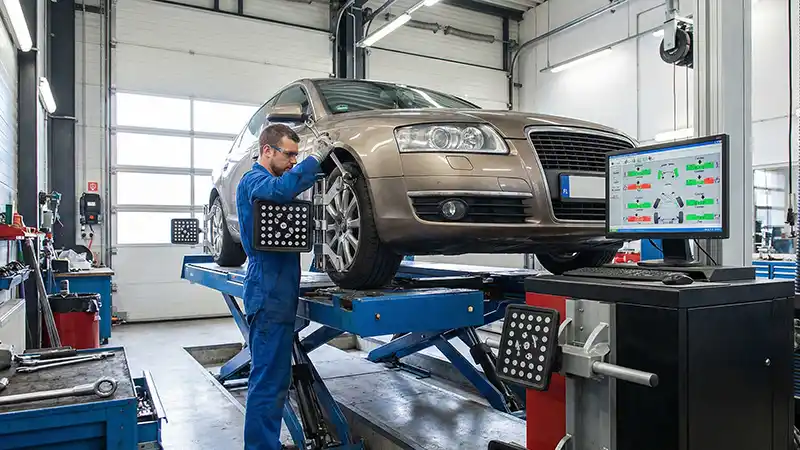
This process involves adjusting three key angles:
- Camber: This is the inward or outward tilt of the top of the tire when viewed from the front of the vehicle. Too much negative camber (tilting in) or positive camber (tilting out) can cause wear on the tire edges and affect handling.
- Toe: This refers to the direction your tires are pointing when viewed from above, similar to looking down at your feet. ‘Toe-in’ means the fronts of the tires are closer together than the rears, while ‘toe-out’ is the opposite. Incorrect toe is a primary cause of premature tire wear.
- Caster: This is the angle of your steering axis when viewed from the side of the vehicle. Caster affects steering stability and the steering wheel’s ability to return to center after a turn. While it doesn’t typically affect tire wear, it’s crucial for straight-line tracking.
A technician uses a specialized alignment machine to measure these angles and adjust them to the manufacturer’s specifications. This precise tuning ensures your car drives straight, handles predictably, and your tires wear evenly.
Top Signs You Need a Wheel Alignment
Your vehicle often provides clear warnings when its alignment is off. Ignoring these symptoms can lead to more significant issues, including compromised safety and the need for premature tire replacement. Here are the seven most common signs to watch for.
1. Vehicle Pulling to One Side
This is the most classic symptom. When driving on a straight, flat road, you may need to apply constant pressure to the steering wheel to keep the car from drifting to the left or right. This pull is a direct result of misaligned wheels fighting against each other, forcing the vehicle off its intended path.
2. Crooked or Off-Center Steering Wheel
When you’re driving straight, your steering wheel should be centered and level. If you notice the emblem in the center of the wheel is tilted to one side while the car is moving in a straight line, it’s a strong indicator that the alignment is incorrect. The wheels might be straight, but the steering system isn’t synchronized with them.
3. Uneven or Rapid Tire Wear
Your tires are a direct window into the health of your alignment. When properly aligned, tires should wear down evenly across their entire tread surface. Misalignment forces specific parts of the tire to carry more load and scrub against the pavement improperly.
- Feathering: This occurs when the tread is smooth on one side and sharp on the other. It’s often a sign of an incorrect toe setting.
- Camber Wear: If the inside or outside edge of your tire is significantly more worn than the rest of the tread, it points to a problem with the camber angle.
- Heel/Toe Wear: This appears as a saw-toothed pattern on the tread blocks and can also be caused by incorrect toe settings.
4. Squealing Tires
If you hear your tires squealing or scrubbing when making routine turns at normal speeds, it can be a sign of poor alignment. The sound is caused by the tire being dragged sideways across the pavement instead of rolling smoothly, a direct result of improper angles.
5. Steering Feels Loose or Sloppy
A vehicle with correct alignment should feel responsive and stable. If the steering feels loose, vague, or requires more movement than usual to get the car to turn, it could be related to alignment. This symptom can also point to worn suspension parts, which often go hand-in-hand with alignment problems.
6. Steering Wheel Doesn’t Return to Center
After completing a turn, the steering wheel should naturally start to return to its center position on its own. This is largely controlled by the caster angle. If you find yourself having to manually turn the wheel back to straight after every turn, it’s a sign that your caster or another alignment angle is off.
7. Steering Wheel Vibration
While steering wheel vibration is most commonly caused by unbalanced tires, it can sometimes be a symptom of severe misalignment. If the vibration is accompanied by any of the other signs on this list, especially pulling, it’s wise to have the alignment checked along with the tire balance.
What Causes Your Wheels to Go Out of Alignment?
A vehicle’s alignment doesn’t just drift off over time without reason. It’s almost always caused by external forces or component wear. Understanding the causes can help you be more mindful while driving.
- Potholes and Road Imperfections: The most common culprit. Hitting a deep pothole, even at low speed, can deliver a significant jolt to your suspension, knocking components out of their precise settings.
- Hitting a Curb: Whether parking or sliding on a slippery road, bumping into a curb can easily force your wheels out of alignment.
- Minor Accidents: Even a small fender-bender can have enough force to bend suspension parts like tie rods or control arms, which will directly impact alignment.
- Wear and Tear: Suspension components like ball joints, bushings, and tie rod ends wear out over time. As they develop looseness or ‘play’, they can no longer hold the alignment angles steady. An alignment on worn parts will not last.
- Suspension Modifications: Installing a lift kit or lowering springs changes your vehicle’s ride height and geometry. A professional alignment is always required after making such modifications to restore proper handling.
The Critical Benefits of a Proper Wheel Alignment
Keeping your vehicle properly aligned is not just about fixing an annoying pull. It’s a crucial maintenance task with several important benefits.
- Enhanced Safety: A properly aligned car is more stable and predictable, especially during emergency maneuvers. It tracks straight and responds accurately to steering inputs.
- Longer Tire Life: By ensuring your tires wear evenly, you can maximize their lifespan and get the full value out of your investment. Misalignment is one of the fastest ways to destroy a new set of tires.
- Improved Fuel Efficiency: When wheels are misaligned, they scrub against the road, increasing rolling resistance. This forces the engine to work harder, which in turn consumes more fuel. A proper alignment can lead to a noticeable improvement in gas mileage.
- A Smoother Ride: Correcting alignment issues reduces vibrations and the feeling of the car ‘wandering’ on the road, resulting in a more comfortable and less fatiguing driving experience.
Wheel Alignment vs. Tire Balancing: What’s the Difference?
Many drivers confuse these two essential services, but they address completely different issues. Both are vital for a smooth ride and long tire life, but they solve separate problems.
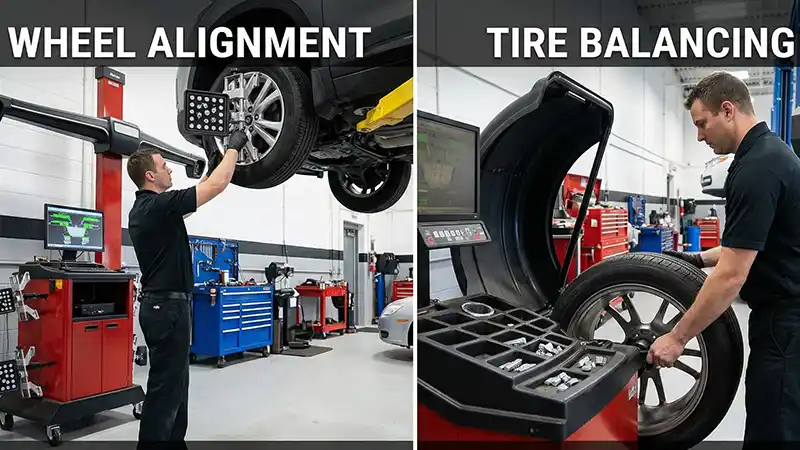
Wheel Alignment focuses on the angles of the wheels in relation to the car’s suspension and the road. Its primary purpose is to ensure straight tracking, proper handling, and even tire wear. The main symptoms it fixes are pulling, crooked steering, and uneven tread wear.
Tire Balancing addresses the weight distribution of the wheel and tire assembly. A technician uses a machine to spin the wheel and identify heavier spots. Small counterweights are then attached to the rim to ensure the weight is distributed evenly. The primary symptom it fixes is vibration, especially at highway speeds.
Think of it this way: alignment is about the direction the wheels are pointing, while balancing is about how smoothly they spin.
How Often Should You Get a Wheel Alignment?
There is no single, universal schedule for wheel alignments, but there are several reliable guidelines. It’s best to consult your vehicle’s owner’s manual for manufacturer-specific recommendations.
As a general rule, consider an alignment check:
- Once every year or every 12,000 miles.
- Whenever you purchase a new set of tires.
- After any significant impact with a pothole or curb.
- After you’ve had suspension components replaced.
- Anytime you notice one of the warning signs mentioned above.
Regular checks can catch minor issues before they cause significant tire damage, saving you from larger expenses down the road.
What to Expect During a Wheel Alignment Service
A modern wheel alignment is a high-tech process. When you take your vehicle in, a technician will first perform a pre-alignment inspection of the tires and suspension components to ensure there are no worn parts that would prevent the alignment from holding.
The process typically involves these steps:
- The vehicle is raised on a specialized alignment rack.
- Sophisticated sensors or reflective targets are mounted on each of the four wheels.
- A computer system, using lasers or cameras, measures the current camber, toe, and caster angles.
- The system compares these measurements to the vehicle manufacturer’s specifications.
- The technician then makes precise adjustments to various suspension components (like tie rods and control arms) to bring the angles back into the correct range.
- Finally, they will provide a printout showing the ‘before’ and ‘after’ measurements.
Frequently Asked Questions About Wheel Alignment
How can I tell if I need a wheel alignment at home?
You can perform a simple test by driving on a straight, level road and briefly letting go of the wheel. If the car pulls to one side, or if your steering wheel is crooked when driving straight, you likely need an alignment. Also, visually inspect your tires for uneven wear patterns across the tread.
What does it feel like when you need a wheel alignment?
It often feels like the car is fighting you to stay in a straight line, requiring constant steering correction. You might feel a distinct pull or drift to the left or right. The steering wheel may also feel off-center or less responsive than usual.
Can I drive my car if it needs a wheel alignment?
While you can usually drive a car with a minor misalignment, it is not recommended for an extended period. It compromises safety, reduces handling precision, and causes premature, costly tire wear. If the pulling is severe, you should have it serviced immediately.
What’s the difference between a two-wheel and four-wheel alignment?
A two-wheel alignment, or front-end alignment, adjusts only the front wheels’ angles. A four-wheel alignment adjusts all four wheels and is necessary for all-wheel-drive vehicles and most modern front-wheel-drive cars that have adjustable rear suspensions.
Does hitting a pothole mean I need an alignment?
Not always, but it is a very common cause. A hard impact from a pothole or curb can easily knock your suspension components out of their precise settings. If you notice any changes in steering or handling after an impact, an alignment check is a wise precaution.
Will a wheel alignment fix a vibrating steering wheel?
Not usually. A vibrating steering wheel is most often a symptom of unbalanced tires, not poor alignment. While the two services are often performed together, tire balancing addresses weight distribution to stop vibrations, whereas alignment corrects wheel angles to ensure straight tracking.
Conclusion
Paying attention to the signs you need a wheel alignment is key to maintaining your vehicle’s safety, performance, and efficiency. A vehicle that pulls to one side, has a crooked steering wheel, or shows uneven tire wear is telling you that its suspension needs attention. By addressing these issues promptly, you protect your investment in your tires and ensure a safer, more enjoyable drive. If you notice any of these symptoms, it’s best to consult a trusted mechanic for a professional inspection and alignment service.
{“@context”:”https://schema.org”,”@type”:”Article”,”headline”:”7 Clear Signs You Need a Wheel Alignment (And Why It Matters)”,”mainEntityOfPage”:”https://autofixnotes.com/?p=1097″,”datePublished”:”2025-12-11T13:04:36+00:00″,”dateModified”:”2025-12-11T13:04:36+00:00″}