
A flashing check engine light is the most urgent warning your car can give you short of a temperature gauge in the red. Unlike a steady light — which means “get this checked soon” — a flashing light means stop driving aggressively right now. This guide explains exactly what’s happening, why it’s serious, what causes it, and the fastest way to diagnose and fix it.
Flashing vs. Solid Check Engine Light: What’s the Difference?
Not all check engine lights carry the same urgency. The behavior of the light is your first clue about severity.
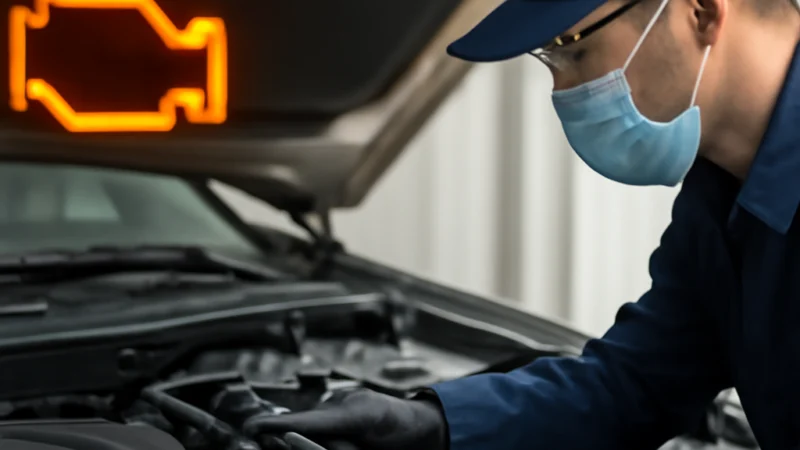
- Solid/Steady light — A fault has been detected, but it’s not actively causing damage right now. Common causes: loose gas cap, failing O2 sensor, EVAP leak. You have time to schedule a diagnostic appointment.
- Flashing/Blinking light — An active, severe fault is happening right now that is likely damaging your catalytic converter with every passing mile. Pull over or reduce speed immediately.
- Flashing then stops — A fault was detected during a specific driving condition but the ECU didn’t confirm it enough times to leave the light on permanently. Still requires diagnosis — see the intermittent flashing section below.
The technical difference: a solid light means the OBD-II system has confirmed a stored fault code. A flashing light means the system has detected an active misfire severe enough to damage the catalytic converter — it’s a live emergency signal, not just a stored record.
What a Flashing Check Engine Light Actually Means
When your check engine light flashes, it almost always means the engine is misfiring severely. Here’s the chain of events happening inside your engine right now:
- One or more cylinders fail to ignite the air-fuel mixture properly.
- Unburnt fuel exits the cylinder and enters the exhaust system.
- That raw fuel ignites inside the catalytic converter instead of the combustion chamber.
- The catalytic converter temperature spikes — it can reach over 1,800 degrees F in minutes.
- The ceramic honeycomb inside the converter melts and collapses, destroying a part that can cost $800–$2,500+ to replace.
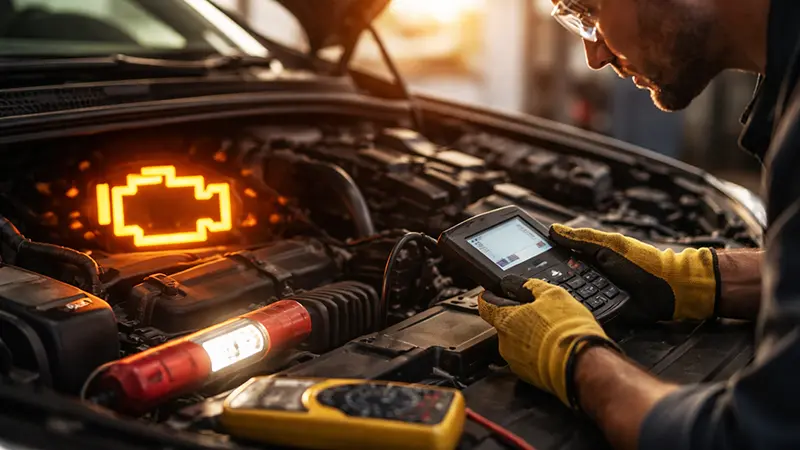
This is why the flashing light exists as a separate signal — the engineers who designed OBD-II knew that misfire damage to the catalytic converter happens fast, and they wanted drivers to know immediately, not just at their next oil change.
9 Causes of a Flashing Check Engine Light (With Codes and Fix Costs)
These are the most common root causes, ordered from most to least frequent. Each one can trigger misfire codes (P0300–P0308) or related codes that cause the light to flash.
1. Worn or Fouled Spark Plugs
OBD codes: P0300 (random misfire), P0301–P0308 (cylinder-specific misfire)
Spark plugs ignite the air-fuel mixture. When they wear down, get fouled with carbon or oil, or develop the wrong gap, they produce a weak or missing spark — and the cylinder misfires. Spark plugs are a wear item; most should be replaced every 30,000–100,000 miles depending on type (copper vs. iridium).
Symptoms alongside flashing light: Rough idle, hesitation under acceleration, poor fuel economy.
DIY difficulty: Easy — basic hand tools. Part cost: $20–$80 for a full set.
2. Failing Ignition Coils
OBD codes: P0300–P0308, P0351–P0358 (ignition coil circuit)
Each cylinder has an ignition coil (on modern coil-on-plug systems) or shares coils via a distributor. A cracked coil, heat-damaged coil, or one that’s arcing to ground will cut spark to that cylinder entirely — causing a hard misfire. Coil failure is especially common on high-mileage engines and in hot climates.
Symptoms: Strong vibration, specific cylinder misfire code, rough idle that worsens under load.
DIY difficulty: Easy. Part cost: $20–$80 per coil. Swap the suspect coil to another cylinder — if the misfire code follows the coil, that’s your problem.
3. Clogged or Dead Fuel Injectors
OBD codes: P0200–P0212 (injector circuit), P0300–P0308
Fuel injectors spray a precise mist of fuel into each cylinder. A clogged injector delivers too little fuel (lean misfire); a stuck-open injector delivers too much (rich misfire with flooding). Either condition causes a misfire severe enough to flash the light.
Symptoms: Rough idle, poor throttle response, smell of fuel, increased fuel consumption.
DIY difficulty: Moderate. Fix cost: $50–$150 for professional injector cleaning; $150–$400 per injector to replace.
4. Low Fuel Pressure (Failing Fuel Pump or Clogged Filter)
OBD codes: P0087 (fuel rail pressure too low), P0300–P0308
If the fuel pump can’t maintain adequate pressure — or a severely clogged fuel filter restricts flow — the engine starves for fuel under load. This causes multiple cylinders to misfire simultaneously, which triggers the flashing light especially during acceleration or at highway speed.
Symptoms: Light flashes most under hard acceleration or at high RPM; may run fine at idle. Engine may surge or hesitate.
DIY difficulty: Moderate to hard. Fix cost: $20–$80 for fuel filter; $400–$700 for fuel pump replacement.
5. Vacuum Leaks
OBD codes: P0171/P0174 (system too lean), P0300–P0308
Vacuum hoses route engine vacuum to various systems — brake booster, PCV, EVAP, and more. A cracked or disconnected hose introduces unmetered air into the intake manifold, leaning out the air-fuel mixture. Lean conditions cause misfires, particularly at idle or low load.
Symptoms: Hissing sound from engine bay, rough idle that improves slightly at higher RPM, lean codes alongside misfire codes.
DIY difficulty: Easy to find with a smoke machine or carb cleaner spray; easy to fix. Part cost: $5–$50 for hoses.
6. Bad Camshaft or Crankshaft Position Sensor
OBD codes: P0335–P0338 (crankshaft position sensor), P0340–P0349 (camshaft position sensor)
These sensors tell the ECU exactly where each piston is in its cycle so fuel injection and ignition timing can be perfectly synchronized. When they fail or give erratic signals, the ECU loses its timing reference — causing misfires across multiple cylinders, or random misfires that come and go.
Symptoms: Intermittent stalling, hard starts, flashing light that comes and goes, random misfire codes with no single cylinder identified.
DIY difficulty: Moderate. Part cost: $20–$100; labor: $80–$200.
7. Low Engine Compression (Valvetrain or Piston Issues)
OBD codes: P0300–P0308 (misfire), no compression-specific code — confirmed by compression test
If a cylinder has low compression due to worn piston rings, a burnt valve, or a blown head gasket, it can’t build enough pressure to properly ignite the mixture. This is a mechanical misfire — no amount of new spark plugs or coils will fix it. A compression test will reveal it.
Symptoms: Persistent misfire on one specific cylinder that doesn’t respond to ignition/fuel fixes, white/blue exhaust smoke (head gasket), oil consumption.
DIY difficulty: Diagnosis is easy (compression tester, ~$30). Repair is major engine work. Fix cost: $500–$3,000+ depending on cause.
8. Catalytic Converter Beginning to Clog
OBD codes: P0420/P0430 (catalyst efficiency below threshold), P0300 (backpressure misfire)
A catalytic converter that’s already partially failed can create excessive exhaust backpressure, which interferes with proper exhaust scavenging and causes misfires — especially at high RPM. In this case, the converter is both a symptom of previous misfires AND a new cause of more misfires.
Symptoms: Power loss at high RPM, rotten egg smell, light that was previously solid (P0420) has now started flashing.
Fix cost: $800–$2,500+ depending on vehicle and whether OEM or aftermarket converter.
9. ECU or Wiring Fault
OBD codes: Multiple codes across unrelated systems, or U-codes (network/communication faults)
Rare, but a corroded connector, damaged wiring harness, or ECU malfunction can cause false misfire signals or actual misfires by sending wrong timing or fuel commands. Usually accompanied by multiple unrelated codes and symptoms that don’t fit a single mechanical cause.
DIY difficulty: Hard — requires wiring diagrams and a professional-grade scanner. Fix cost: $200–$1,500+.
When Your Check Engine Light Flashes Then Stops
An intermittent flashing light — one that flashes for a few seconds or minutes then goes back to solid or off — is a sign of a conditional misfire. The ECU detected a misfire severe enough to trigger the flash, but the condition resolved itself (or the driving condition changed) before a permanent fault was stored.
Common scenarios for intermittent flashing:
- Cold start misfire — Misfires during cold starts that clear once the engine warms up. Often caused by fouled spark plugs or a cold-sensitive ignition coil.
- Load-dependent misfire — Light flashes during hard acceleration or at highway speed (fuel pressure or injector issue) but is fine at idle.
- Intermittent sensor fault — A camshaft/crankshaft sensor with a marginal connection causes random misfires that come and go.
- Bad gasoline — A tank of water-contaminated or low-quality fuel can cause temporary misfires that resolve after the fuel burns off.
What to do: Don’t ignore it because the light stopped. The misfire happened — and it may have already damaged the catalytic converter slightly. Read the codes immediately (even if the light is now off, pending codes may still be stored) and address the cause. See: Check Engine Light Blinking When Accelerating for load-specific flashing scenarios.
Immediate Action Plan: What to Do Right Now
If your check engine light is currently flashing, here’s what to do in order:
Red Flags: Pull Over Immediately If You See These
- Engine shaking violently or vibrating through the steering wheel
- Loud knocking, pinging, or popping from the engine
- Smoke from under the hood or from the exhaust
- Strong smell of burning or raw fuel
- Sudden significant loss of power
- Temperature gauge rising toward hot
If any of these are present: pull over safely, turn off the engine, and call for a tow. Do not attempt to drive further.
If the Car Seems to Be Running Mostly Normally:
- Immediately reduce speed — ease off the throttle, avoid acceleration, drop below 50 mph if safe.
- Turn off non-essential electrical loads — AC, heated seats, etc. Reduce engine load.
- Drive calmly to the nearest safe stop — a parking lot or side street. Avoid highways.
- Turn off the engine — once safely stopped. Let it cool for a few minutes.
- Check the gas cap — unlikely to cause flashing, but takes 5 seconds to rule out.
- Read the codes — plug in an OBD-II scanner or drive to the nearest auto parts store (AutoZone, O’Reilly, Advance Auto Parts all read codes for free).
- Do not clear codes yet — the stored codes are your diagnostic roadmap. Clearing them erases that information.
How to Diagnose a Flashing Check Engine Light (Step-by-Step)
Once you’ve read the codes, here’s a systematic approach to finding the actual cause:
Step 1: Read All Codes and Note Which Cylinder
Connect an OBD-II scanner and write down every code. A P0301 means cylinder 1 misfire — this is your starting point. A P0300 (random/multiple) suggests a fuel, sensor, or compression issue affecting multiple cylinders rather than one ignition component. See our complete OBD-II codes list for code meanings.
Step 2: Inspect Spark Plugs and Ignition Coils First
These are the most common cause and the easiest to check. Remove the spark plug from the misfiring cylinder — look for carbon fouling, oil deposits, erosion on the electrode, or incorrect gap. If the plug looks bad, replace the whole set. For coils: swap the coil from the misfiring cylinder to a known-good cylinder and re-scan. If the misfire code moves with the coil, replace that coil.
Step 3: Check for Vacuum Leaks
With the engine idling, spray carb cleaner carefully around vacuum hose connections, the intake manifold gasket, and the throttle body. If the idle smooths out when you hit a particular spot, you’ve found a leak. A proper smoke test is more reliable and safer.
Step 4: Test Fuel Pressure
If multiple cylinders are misfiring and plugs/coils check out, connect a fuel pressure gauge. Normal fuel pressure varies by vehicle (typically 30–80 PSI) — check your service manual. Low pressure points to a weak pump or clogged filter.
Step 5: Compression Test
If you’ve replaced spark plugs and coils, checked for vacuum leaks, and verified fuel pressure — and the misfire persists — do a compression test. Remove all spark plugs, disable the fuel system, and crank the engine to read compression in each cylinder. A cylinder significantly lower than the others (or below ~90 PSI) has a mechanical issue.
Step 6: Professional Diagnosis
If basic checks haven’t found the cause, a professional can use live data streaming, an oscilloscope, and advanced tools to diagnose fuel injector pulse width, ignition waveform analysis, and sensor signal quality. This is worth the diagnostic fee before replacing expensive parts blindly. See: Check Engine Light Diagnosis Guide.
Can You Drive With a Flashing Check Engine Light?
The short answer: no — not as normal driving.
Here’s the honest breakdown by scenario:
- Light is flashing + car is shaking badly: Pull over immediately. Do not drive further. Call a tow.
- Light is flashing + driving feels mostly normal: Reduce speed, avoid acceleration, drive slowly to the nearest shop or safe stopping point only. Every additional mile risks catalytic converter damage.
- Light flashed briefly then went solid or off: You can drive cautiously for a short distance, but get it diagnosed today. Check for stored codes immediately.
The cost of ignoring a flashing light: A misfire that destroys a catalytic converter turns a $30–$100 spark plug or coil repair into an $800–$2,500+ catalytic converter job. It’s not worth it.
Real-World Repair Costs for a Flashing Check Engine Light
What you’ll actually pay depends on the root cause. Here’s a realistic cost guide:
- Spark plugs (full set): $50–$200 parts + labor (DIY: $20–$80 in parts only)
- Ignition coil(s): $80–$300 per coil parts + labor (DIY: $20–$80 per coil)
- Fuel injector cleaning: $100–$200 at a shop
- Fuel injector replacement: $200–$600 per injector (parts + labor)
- Fuel pump replacement: $400–$900 total
- Fuel filter replacement: $50–$200
- Vacuum hose repair: $50–$200
- Camshaft/crankshaft position sensor: $100–$300
- Catalytic converter replacement: $800–$2,500+ (the cost of ignoring a misfire)
- Head gasket repair: $1,500–$4,000
Diagnostic fee: $75–$150 at most shops, usually applied to any repair you authorize.
Preventative Maintenance to Avoid a Flashing Check Engine Light
Most flashing check engine lights are preventable with routine maintenance:
- Replace spark plugs on schedule — Copper plugs every 30,000 miles; iridium/platinum every 60,000–100,000 miles. Don’t wait until they fail.
- Address a solid check engine light promptly — A steady light that’s ignored can escalate into a flashing one. An O2 sensor code left unaddressed causes the ECU to run a bad fuel mixture, which eventually causes misfires. See: Check Engine Light Codes Guide.
- Keep up with oil changes — Oil-fouled spark plugs from low oil or burning oil are a major cause of misfires. See: How Often Should I Change My Oil.
- Use quality fuel — Low-quality fuel or contaminated fuel from suspicious stations can cause temporary misfires.
- Inspect hoses annually — Especially on vehicles over 80,000 miles. A $10 vacuum hose can prevent a $1,000 converter.
- Don’t ignore rough idle or hesitation — These are pre-misfire symptoms. Fix them before they become a flashing light emergency. See: Check Engine Light and Rough Idle.
Frequently Asked Questions About Flashing Check Engine Lights
What is the most common reason for a check engine light flashing?
Engine misfire is the most common cause — specifically a bad spark plug or failed ignition coil on one cylinder. The P0301–P0308 (cylinder-specific misfire) codes are the most frequently seen alongside a flashing check engine light. Check the spark plugs and ignition coils first — they account for the majority of cases.
How serious is a flashing check engine light compared to a solid one?
Significantly more serious. A solid light means a fault has been logged but isn’t actively causing damage right now. A flashing light means an active misfire is sending unburnt fuel into your catalytic converter this moment, and every mile you drive is risking a very expensive converter replacement. It’s the difference between “schedule an appointment” and “stop driving aggressively right now.”
Can bad spark plugs cause the check engine light to flash?
Yes — this is actually the single most common cause. A badly fouled or worn spark plug causes a hard misfire in that cylinder. If the misfire is severe enough, the ECU triggers the flashing light warning. Replacing the spark plugs often resolves the issue completely.
My check engine light is flashing and my car is shaking — what do I do?
This combination means a severe misfire is actively happening. Pull over immediately, turn off the engine, and do not drive the vehicle further. The shaking is the engine running on fewer cylinders than designed. Call a tow truck or mechanic. Continuing to drive risks destroying the catalytic converter and potentially causing further internal engine damage.
Why is my check engine light flashing but no misfire code stored?
This can happen when a misfire is intermittent or happens at a specific RPM/load threshold that the OBD-II system hasn’t confirmed enough times to store a permanent code. A pending code may be present (check for P0300 pending). It can also indicate a crankshaft or camshaft position sensor issue, or an ECU/wiring fault. Read codes with a scanner that shows pending OBD-II codes as well as confirmed ones.
Can a loose gas cap cause a flashing check engine light?
No. A loose or missing gas cap causes an EVAP system leak code (P0440, P0442, P0455) which triggers a solid check engine light — not a flashing one. The flashing light is specifically reserved for active misfires that threaten catalytic converter damage.
Will disconnecting the battery fix a flashing check engine light?
Only temporarily. Disconnecting the battery clears the stored codes, which will turn the light off — but the underlying problem remains. Once you drive the car enough for the OBD-II monitors to run their checks, the light will return. More importantly, clearing codes erases your diagnostic data, making it harder for a mechanic to trace the cause. See: How to Properly Reset Your Check Engine Light.
Is it safe to drive with a flashing check engine light for a short distance?
Only if absolutely necessary, and only very slowly and without acceleration. Even a short drive at normal speed with a severe misfire can partially melt the catalytic converter. If the car is shaking badly, smoking, or making loud noises — don’t drive it at all. The $150 tow truck fee is far cheaper than a $2,000 catalytic converter.
Conclusion
A flashing check engine light is your car’s emergency signal — not something to drive through until your next oil change. In most cases it means an engine misfire is actively threatening your catalytic converter. The cause is usually something fixable and affordable (spark plugs, ignition coils, vacuum leak) — but only if you address it before the converter goes.
Read the codes immediately (free at any auto parts store), identify the misfiring cylinder, and start with the spark plugs and ignition coils. Most flashing check engine lights are resolved within an afternoon. If basic parts don’t fix it, use our Check Engine Light Diagnosis Guide to go deeper, or consult our complete check engine light codes guide to understand what every code means.
Related guides: Check Engine Light Blinking When Accelerating | Check Engine Light and Rough Idle | Engine Light and Traction Control Light On | How to Read Check Engine Codes | How to Reset Check Engine Light
{“@context”:”https://schema.org”,”@type”:”Article”,”headline”:”Check Engine Light Flashing: What It Means & What To Do Immediately”,”mainEntityOfPage”:”https://autofixnotes.com/?p=773″,”datePublished”:”2025-12-04T18:35:45+00:00″,”dateModified”:”2026-03-04T00:00:00+00:00″}
