
The most common and recommended tire rotation pattern for a front-wheel drive (FWD) vehicle is the forward cross. In this pattern, the front tires are moved directly back to the rear on the same side. The rear tires are then moved to the front but cross over to the opposite sides, with the rear-left tire going to the front-right and the rear-right tire going to the front-left.
- Even Wear: Tire rotation is critical for balancing the wear between the front and rear tires on a FWD car.
- Longer Tire Life: Regular rotation can significantly extend the lifespan of your tire set, saving you money in the long run.
- Improved Safety: Evenly worn tires provide more predictable handling, traction, and braking performance.
- The Forward Cross: This specific pattern is designed to address the unique wear characteristics of front-wheel drive vehicles.
Why Regular Tire Rotation is Non-Negotiable for Vehicle Health
Tire rotation is one of the most fundamental and impactful maintenance tasks you can perform for your vehicle. It involves systematically moving each tire to a different position on the car. While it may seem simple, this process is essential for achieving even tread wear across all four tires, which leads to a cascade of benefits for your vehicle’s performance, safety, and longevity.
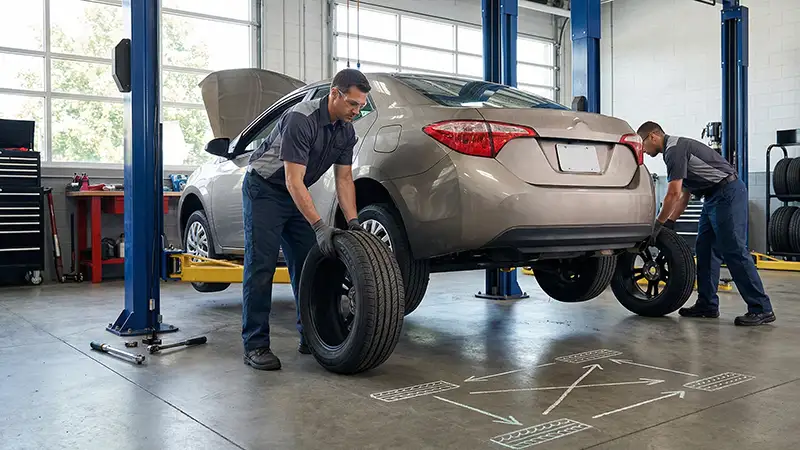
The primary goal is to counteract the uneven wear patterns that naturally occur. Factors like weight distribution, drivetrain forces, and turning habits cause tires in different positions to wear down at different rates and in different ways. By rotating them, you allow each tire to spend time in all positions, effectively balancing out this wear over time.
Key Benefits of Consistent Tire Rotation
- Maximizes Tire Lifespan: The most direct benefit is getting the most miles out of your investment. Without rotation, your front tires on a FWD car would wear out long before the rears, forcing a premature replacement of the set.
- Enhances Safety and Performance: Even tread depth is crucial for stable handling, especially in adverse weather conditions. Tires with consistent wear provide better grip for cornering and shorter stopping distances.
- Maintains Vehicle Warranty: Many tire manufacturers require proof of regular tire rotation to keep the mileage warranty valid. Neglecting this service could void your coverage.
- Improves Fuel Economy: While the effect is minor, properly maintained and evenly worn tires have less rolling resistance, contributing to slightly better fuel efficiency.
How Drivetrains Affect Tire Wear: FWD vs. RWD vs. AWD
The ideal tire rotation pattern is determined by your vehicle’s drivetrain—the system that delivers power from the engine to the wheels. Each type of drivetrain places different demands on the tires, resulting in unique wear patterns.
Front-Wheel Drive (FWD)
In a FWD vehicle, the front wheels do most of the work. They are responsible for pulling the car forward (acceleration), steering, and handling the majority of the braking force. This concentration of tasks causes the front tires to wear down significantly faster than the rear tires. The outer edges of the front tires also tend to wear more quickly from cornering forces.
Rear-Wheel Drive (RWD)
In a RWD vehicle, the tasks are more evenly distributed. The rear wheels handle acceleration, while the front wheels are primarily responsible for steering. While this is more balanced than FWD, the rear tires will still typically wear faster than the fronts. The rotation pattern for RWD is often the opposite of FWD, known as the rearward cross.
All-Wheel Drive (AWD)
AWD systems send power to all four wheels, though the distribution of that power can vary. This generally results in the most even wear of any drivetrain, but rotation is still critical. Even small differences in tread depth between tires on an AWD vehicle can strain the complex drivetrain components. The most common pattern for AWD is the X-pattern, where all four tires are swapped diagonally.
The Official Front Wheel Drive Tire Rotation Pattern Explained
For vehicles with a front-wheel drive system, the universally recommended method is the front wheel drive tire rotation pattern known as the ‘forward cross’. This specific sequence is designed to counteract the heavy wear experienced by the front tires, which handle both steering and power delivery.
Here is a breakdown of the movement:
- The Front-Left Tire moves straight back to the Rear-Left position.
- The Front-Right Tire moves straight back to the Rear-Right position.
- The Rear-Left Tire moves diagonally to the Front-Right position.
- The Rear-Right Tire moves diagonally to the Front-Left position.
The logic behind this pattern is simple yet effective. The hardworking front tires, which have worn down the fastest, are moved to the rear where they have fewer responsibilities and can wear more evenly. The less-worn rear tires are moved to the front to take on the demanding tasks of steering and acceleration. Crossing them as they move forward helps balance side-to-side wear that occurs from turning and road crowning.
Essential Tools and Safety Gear for a DIY Tire Rotation
Before you begin, gathering the right equipment is crucial for a safe and successful job. Attempting this task without the proper tools can be dangerous and may damage your vehicle.
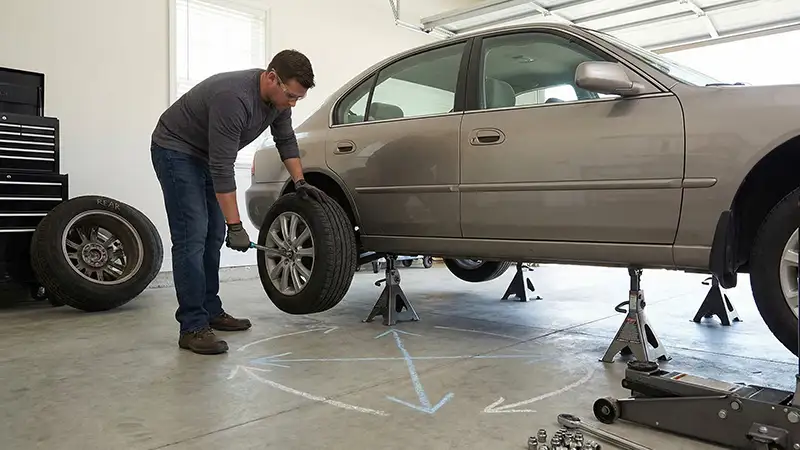
Required Tools:
- Floor Jack: A hydraulic floor jack is much safer and more stable than the emergency scissor jack included with most cars.
- Jack Stands: This is a non-negotiable safety item. Never work under a vehicle supported only by a jack. You will need at least two jack stands.
- Lug Wrench or Impact Wrench: A star-shaped lug wrench provides better leverage than a standard one. An impact wrench can speed up the process, but a torque wrench is still needed for final tightening.
- Torque Wrench: This is essential for tightening the lug nuts to the manufacturer’s specified torque. Over-tightening can damage the wheel and studs, while under-tightening can cause a wheel to come loose.
- Wheel Chocks: These prevent the vehicle from rolling while it is being lifted.
Safety Gear:
- Gloves: Protect your hands from dirt, grease, and potential scrapes.
- Safety Glasses: Protect your eyes from flying debris or dirt.
A Step-by-Step Guide to Rotating Your FWD Tires at Home
With your tools ready, you can perform a tire rotation in your own garage. Always prioritize safety and take your time. If you are ever unsure, it’s best to consult a professional.
SAFETY FIRST: Perform this job on a flat, level, and solid surface like a concrete garage floor or driveway. Never work on soft ground or an incline.
- Secure the Vehicle: Engage the parking brake firmly. Place wheel chocks behind the rear wheels to prevent any movement.
- Loosen the Lug Nuts: Before lifting the car, use your lug wrench to break the lug nuts loose on the front two wheels. Do not remove them completely; just turn them about a half-turn counter-clockwise. This is much easier and safer to do while the tire is on the ground.
- Lift the Vehicle: Position your floor jack under one of the vehicle’s designated front lift points (consult your owner’s manual for exact locations). Raise the vehicle until the front tire is a few inches off the ground.
- Place Jack Stands: Position a jack stand under a secure frame point near the jack, as recommended by your vehicle’s manufacturer. Slowly lower the jack until the car’s weight rests securely on the jack stand. Repeat the process on the other side of the front of the car.
- Remove the Wheels: With the front of the car securely on jack stands, you can now fully remove the lug nuts and take off both front wheels.
- Lift the Rear and Perform the Rotation: Move to the rear of the car. Jack up one side, remove the wheel, and move it to the opposite front position (e.g., rear-right to front-left). Install it by hand-tightening the lug nuts. Now, take the front wheel from that side and move it to the rear position on the same side (e.g., front-left to rear-left). Repeat this process for the other side.
- Lower the Vehicle: Once all wheels are in their new positions and the lug nuts are snug, raise the vehicle slightly with the jack to remove the jack stands. Carefully lower the vehicle until all four tires are back on the ground.
- Torque the Lug Nuts: This is a critical step. Use your torque wrench to tighten the lug nuts in a star pattern to the specification listed in your owner’s manual. This ensures even pressure and prevents warping the brake rotor.
- Check Tire Pressure: After a rotation, it’s a good practice to check the air pressure in all four tires and adjust as needed to the recommended PSI.
What About Directional Tires? A Special Case
Not all tires are the same. Directional tires are designed with a tread pattern that is optimized to rotate in only one direction. This design is excellent for channeling water away and providing superior handling, but it changes the rotation pattern.
You can identify directional tires by an arrow or a similar marking on the sidewall indicating the required direction of rotation. Because they cannot be swapped from one side of the car to the other without being remounted on the wheel, the rotation pattern is simpler:
- The Front-Left Tire is swapped with the Rear-Left Tire.
- The Front-Right Tire is swapped with the Rear-Right Tire.
You cannot perform a cross pattern on directional tires as it would cause them to rotate backward, severely compromising their performance and safety.
Incorporating a Full-Size Spare into Your Rotation Schedule
If your vehicle is equipped with a full-size, matching spare tire, it’s highly beneficial to include it in your rotation schedule. This is known as a 5-tire rotation. It ensures all five tires wear at the same rate, extending the life of the entire set and keeping the spare in good, usable condition.
For a FWD vehicle, a common 5-tire rotation pattern is as follows:
- The spare tire moves to the right-rear position.
- The right-rear tire moves to the right-front position.
- The right-front tire moves to the left-rear position.
- The left-rear tire moves to the left-front position.
- The left-front tire becomes the new spare.
This pattern ensures every tire spends time at each position, including time off the vehicle as the spare.
How Often Should You Rotate Your Tires on a FWD Car?
The general recommendation for tire rotation is every 5,000 to 7,500 miles. For many drivers, this interval conveniently aligns with their vehicle’s oil change schedule, making it an easy maintenance item to remember.
However, the best source of information is always your vehicle’s owner’s manual. The manufacturer will provide the most accurate maintenance schedule based on your specific car’s design and engineering. Aggressive driving habits or frequently carrying heavy loads may necessitate more frequent rotations.
Frequently Asked Questions
- What is the best tire rotation pattern for a front wheel drive car?
- The best and most widely recommended pattern is the forward cross. In this method, the front tires move straight to the back, and the rear tires cross over to the opposite sides as they move to the front.
- How is the front wheel drive tire rotation pattern different from an AWD pattern?
- The FWD forward cross pattern moves front tires straight back. In contrast, a common AWD pattern is the X-pattern, where all four tires are moved diagonally to the opposite corner of the vehicle to ensure even wear across a more complex drivetrain.
- What happens if you don’t follow the correct tire rotation pattern for FWD?
- Failure to rotate tires on a FWD car leads to rapid wear on the front tires. This results in a shorter tire lifespan, compromised handling, reduced traction in wet conditions, and potentially voiding your tire warranty.
- Can I just move the front tires to the back and back to the front on a FWD car?
- While moving front tires straight back and rear tires straight forward is better than no rotation, it is not ideal. The recommended forward cross pattern is superior because crossing the rear tires to the front helps balance out side-to-side wear from cornering.
- Do I need to rebalance my wheels after performing a tire rotation?
- Tire rotation and wheel balancing are separate services. You do not typically need to rebalance your wheels every time you rotate them. Balancing is only necessary if you notice vibrations at speed, which indicates a wheel is out of balance.
- Is the front wheel drive tire rotation pattern the same if I have directional tires?
- No, it is different. If you have directional tires, you cannot cross them to the other side of the vehicle. You must only rotate them from front to back on the same side to maintain the correct direction of rotation.
Conclusion
Understanding and applying the correct front wheel drive tire rotation pattern is a key part of responsible vehicle ownership. The forward cross method is specifically designed to combat the unique wear forces on FWD cars, promoting a longer tire life, safer handling, and better overall performance. Regular rotation, performed every 5,000 to 7,500 miles, is a small investment of time that pays significant dividends.
By following the steps outlined in this guide and always prioritizing safety, you can confidently perform this essential maintenance task yourself. If you are ever in doubt, consulting your owner’s manual or a trusted mechanic is always the wisest course of action.
{“@context”:”https://schema.org”,”@type”:”Article”,”headline”:”The Correct Front Wheel Drive Tire Rotation Pattern: A Complete Guide”,”mainEntityOfPage”:”https://autofixnotes.com/?p=1118″,”datePublished”:”2025-12-13T21:13:56+00:00″,”dateModified”:”2025-12-13T21:13:56+00:00″}
