
If your check engine light is blinking while you’re accelerating, don’t ignore it. Unlike a steady light that can wait a day or two, a blinking check engine light during acceleration is your car’s urgent cry for help. It almost always means your engine is misfiring severely enough to destroy your catalytic converter — sometimes within minutes of continued driving.
This guide will walk you through exactly why this happens, what’s causing it, how dangerous it really is, and what steps you should take right now.
- A blinking check engine light means an active, severe engine misfire is happening right now.
- Unburnt fuel entering the exhaust can destroy your catalytic converter within minutes.
- Common causes include bad spark plugs, failing ignition coils, clogged fuel injectors, vacuum leaks, and sensor failures.
- The light blinking specifically during acceleration suggests a load-triggered weakness in the ignition or fuel system.
- Pull over safely, reduce engine load, and get it diagnosed with an OBD-II scanner immediately.
- Repair costs can range from $20 (spark plug) to $2,500+ (catalytic converter replacement) depending on how long you wait.
Blinking vs. Solid Check Engine Light: Why the Difference Matters
Your check engine light, officially called the Malfunction Indicator Lamp (MIL), is controlled by your vehicle’s onboard computer (ECU/PCM). It monitors hundreds of sensors and systems across your engine, transmission, and emissions setup. But not all check engine light warnings are equal — the way the light behaves tells you a lot about urgency.
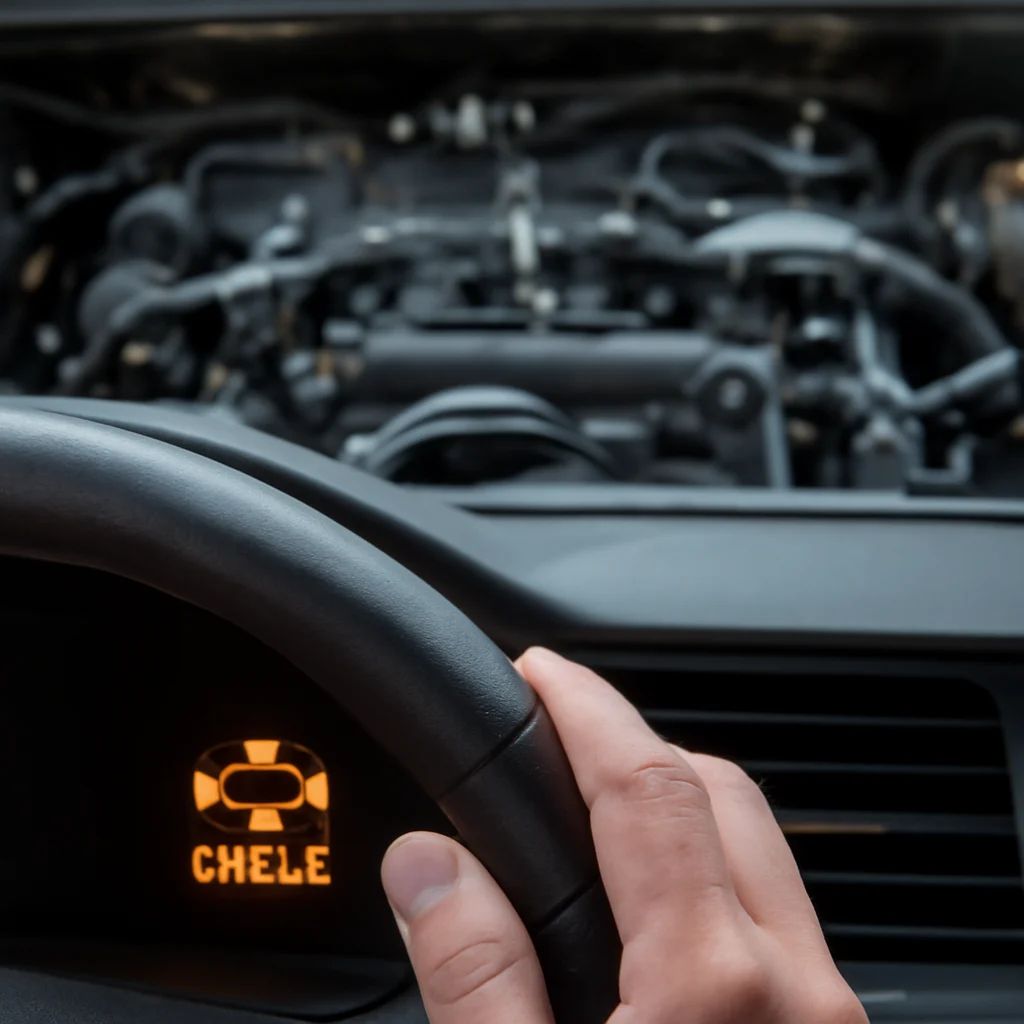
A solid, steady check engine light signals that a fault has been detected, but it’s not an emergency. Issues like a loose gas cap, a slightly lazy oxygen sensor, or a minor emissions problem will trigger a solid light. You can usually drive to a shop at your convenience — just don’t let it sit for weeks.
A blinking or flashing check engine light is an entirely different situation. It means the ECU has detected a severe, active misfire — one serious enough that raw, unburnt fuel is being pushed into the exhaust system right now. That fuel can ignite inside your catalytic converter, which operates at temperatures up to 1,600°F normally but can skyrocket to 2,500°F or more when raw fuel hits it. At those temperatures, the ceramic honeycomb matrix inside the converter melts and collapses, turning a $150 repair into a $1,500+ replacement.
Bottom line: solid light = schedule an appointment soon. Blinking light = pull over now.
Why Does the Check Engine Light Blink Specifically When Accelerating?
The fact that the light blinks only during acceleration — and not when idling or cruising — is actually very useful diagnostic information. Here’s why.
When you press the accelerator, your engine suddenly needs to deliver more power. That means more fuel injected, a stronger spark needed to ignite it, and higher cylinder pressures throughout the combustion process. Any component that’s worn, partially failing, or marginal may handle light driving just fine, but cracks under the increased stress of acceleration.
Think of it like a leaky water pipe. It might hold up under normal pressure, but the moment you open the tap fully, the leak becomes obvious. A weak ignition coil, a partially clogged injector, or a vacuum leak that slightly leans out your mixture — none of these may trigger a misfire at idle, but all of them can cause a cylinder to misfire when you floor it.
That’s why the blinking is load-triggered. The underlying problem exists, but it only becomes severe enough to set a P0300-series misfire code when your engine is working hard.
10 Common Causes of a Blinking Check Engine Light During Acceleration
Several underlying issues can lead to a severe engine misfire and a blinking check engine light during acceleration. Understanding which one is causing your issue is the key to fixing it efficiently.
1. Worn or Fouled Spark Plugs
Spark plugs are the most common culprit behind misfires. As they age, the electrode wears down and the gap widens, requiring more voltage to fire. Under the high cylinder pressures of acceleration, an aging plug simply can’t generate the spark needed. Modern iridium or platinum plugs typically last 60,000–100,000 miles, but many drivers skip this service. Symptoms include rough acceleration, slight hesitation, and reduced fuel economy — all before the light starts blinking.
2. Failing Ignition Coils
Each cylinder has a coil-on-plug (COP) ignition coil (or a shared coil in older designs) responsible for stepping up battery voltage to the 15,000–45,000 volts needed to jump the spark plug gap. When a coil starts to fail, it may work fine at idle but lose the ability to generate enough voltage under load. A misfire code tied to a specific cylinder — like P0301 (cylinder 1) or P0304 (cylinder 4) — combined with the blinking light strongly suggests a failing coil. Swapping the suspect coil to a known-good cylinder and checking if the misfire code follows is a classic diagnostic trick that takes under 10 minutes.
3. Clogged or Failing Fuel Injectors
Fuel injectors spray a precisely atomized mist of fuel into each cylinder. A partially clogged injector delivers less fuel and a poor spray pattern, creating a lean air-fuel mixture in that cylinder. Under normal driving, the ECU compensates, but during hard acceleration — when fuel demand spikes — the clogged injector can’t keep up, triggering a misfire. Look for DTCs in the P020X range alongside your P030X misfire codes.
4. Weak Fuel Pump or Clogged Fuel Filter
A failing fuel pump or a severely restricted fuel filter can drop overall fuel pressure to the engine. Under light load, the system may hold adequate pressure, but during acceleration — when fuel demand is highest — pressure drops below the threshold needed for proper injection. The result is a lean misfire across multiple cylinders, usually showing up as a P0300 (random misfire) code rather than a single-cylinder code.
5. Vacuum Leaks
Your engine depends on precisely measured airflow to calculate the correct fuel mixture. Any crack in a vacuum hose, a loose intake manifold boot, or a failed PCV valve introduces unmetered air into the system — air the ECU doesn’t know about. The engine runs lean as a result. At idle this might cause rough running or a high idle; under acceleration, the lean condition worsens and can trigger misfires. Listen for a high-pitched hissing sound near the intake area with the hood open.
6. Bad Mass Airflow (MAF) Sensor
The MAF sensor measures exactly how much air is entering the engine so the ECU can calculate how much fuel to inject. A dirty or failing MAF sensor sends inaccurate readings, causing the ECU to create either a too-lean or too-rich mixture. Under acceleration, this miscalculation is amplified because the engine is demanding large, rapid changes in fuel delivery. Cleaning a dirty MAF with specialist spray can sometimes resolve it; a failed sensor needs replacement.
7. Faulty Oxygen (O2) Sensors
Oxygen sensors monitor exhaust gas composition and provide feedback to the ECU to fine-tune the fuel mixture. A sluggish or failed upstream O2 sensor can cause the ECU to run the engine too rich or too lean without realizing it. While a bad O2 sensor more commonly triggers a solid check engine light, a severely degraded sensor can contribute to misfires under load, especially on older vehicles with high-mileage sensors.
8. Crankshaft or Camshaft Position Sensor Issues
The crankshaft position sensor (CKP) and camshaft position sensor (CMP) tell the ECU exactly when to fire the spark plugs and inject fuel. If either sensor starts sending erratic or intermittent signals, the timing of combustion events gets thrown off. This can cause misfires that are particularly noticeable under load, when precise timing is most critical. These sensors often fail intermittently at first — working fine when cold, then cutting out as they heat up.
9. Timing Belt or Chain Wear
A stretched timing chain or a worn timing belt can cause the valve timing to slip slightly out of spec. When the camshaft timing is off, the intake and exhaust valves open and close at the wrong moments, disrupting combustion. The result is reduced compression, misfires, and poor performance — symptoms that are especially noticeable under acceleration. This is a more serious and expensive repair but worth checking on high-mileage engines, particularly if you’ve been hearing a rattling noise from the top of the engine.
10. Low Cylinder Compression
If a cylinder has low compression due to worn piston rings, a burnt valve, or a head gasket issue, it can’t generate the pressure needed to achieve proper combustion. This becomes a misfiring cylinder. Low compression misfires are often harder to fix and can indicate serious engine wear. A compression test can quickly confirm this. If compression in one or more cylinders is significantly lower than the others, you’re looking at an internal engine repair.
Is It Dangerous to Drive with a Blinking Check Engine Light?
Yes — and here’s exactly why you should take this seriously rather than just hoping the light goes away.
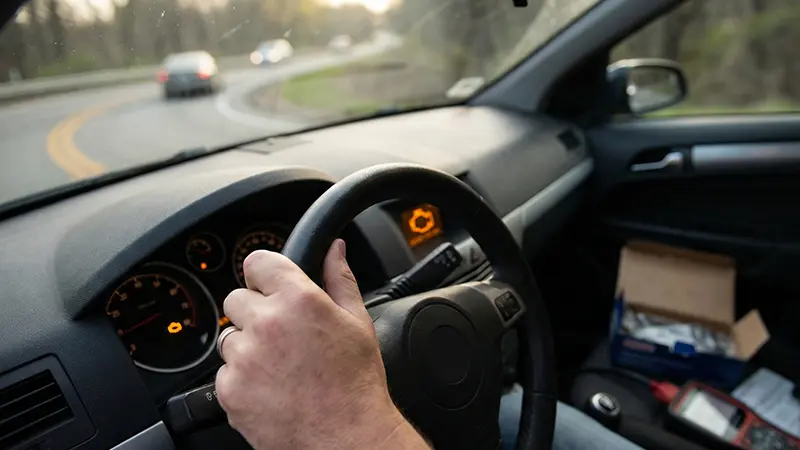
The primary danger is catalytic converter destruction. As explained earlier, raw fuel burning inside the converter can melt its ceramic substrate in a matter of minutes at highway speeds. A replacement catalytic converter on a typical car costs between $800 and $2,500, and on some luxury or performance vehicles it can exceed $3,000. Compare that to the cost of the original misfire cause — often $50–$300 for spark plugs or an ignition coil.
Beyond converter damage, continuing to drive with an active severe misfire causes these problems:
- Engine overheating: Unburnt fuel in the exhaust can cause the oxygen sensor to generate false readings, causing the ECU to add even more fuel, worsening the situation.
- Hydrolocking risk: In extreme cases, raw fuel can wash down cylinder walls, stripping lubrication and causing serious internal damage.
- Progressive engine damage: The misfiring cylinder is under mechanical stress without the benefit of normal combustion. Extended operation can damage piston crowns and cylinder walls.
- Complete stall: A severely misfiring engine may stall unexpectedly, which is a safety hazard especially at highway speeds.
- Failed emissions test: Catalytic converter damage permanently increases tailpipe emissions.
How long can you drive? The honest answer is: as little as possible. If you’re in the middle of a highway with nowhere to pull over, reducing your speed and engine load buys you a short window. But every additional mile at high throttle is adding damage. Drive slowly and directly to the nearest safe stop or shop.
What to Do When Your Check Engine Light Blinks While Accelerating
Here’s the action plan, in order:
Step 1: Reduce Speed and Engine Load Immediately
As soon as you see the light blinking, ease off the accelerator. The misfire is being triggered or worsened by the engine load. Reducing your speed to 30–40 mph significantly reduces the demand on the engine and slows the rate of catalytic converter damage. Turn off any accessories (AC, heated seats) to further reduce load.
Step 2: Find a Safe Place to Pull Over
If it’s safe to do so, pull off the road completely. Turn the engine off and wait a few minutes. Sometimes a brief rest will allow the ECU to reset and the light may stop blinking — though the underlying problem remains. Do not continue highway driving if the light remains blinking after restart.
Step 3: Check for Obvious Symptoms
While stopped, pay attention to: Is the engine running rough or shaking? Do you smell fuel inside or outside the car? Is the exhaust smelling unusually rich (gas-like) or acrid? Is there steam or smoke from under the hood? Any of these alongside the blinking light indicates a more severe situation that warrants a tow rather than driving to a shop.
Step 4: Read the Codes with an OBD-II Scanner
This is the most valuable thing you can do before calling a mechanic. An OBD-II scanner plugs into the port under your dashboard (driver’s side, usually near the steering column) and reads the diagnostic trouble codes stored by the ECU. Key codes to look for:
- P0300: Random/Multiple Cylinder Misfire — multiple cylinders are misfiring, suggesting a fuel pressure or compression issue rather than a single component.
- P0301–P0308: Cylinder-specific misfire (1 through 8). This tells you exactly which cylinder is affected, helping you focus the diagnosis.
- P035X: Ignition coil-related codes.
- P020X: Fuel injector circuit codes.
- P0171/P0174: System too lean — suggests a vacuum leak or MAF/fuel delivery issue.
- P0420/P0430: Catalytic converter efficiency below threshold — may mean the cat is already damaged.
Inexpensive Bluetooth OBD-II scanners cost $15–$40 on Amazon and connect to a free phone app. They’re worth owning for exactly this kind of situation.
Step 5: Perform Basic DIY Checks (If Codes Point to Ignition)
If you have a cylinder-specific P030X misfire code and some basic mechanical confidence, try these before spending money at a shop:
- Swap ignition coils: Move the coil from the misfiring cylinder to a known-good cylinder. Clear codes, drive, and see if the misfire follows the coil. If yes, the coil is bad — replace it (~$30–$80).
- Inspect spark plugs: Pull the plug from the affected cylinder. Black, oily deposits mean rich running or oil burning. White deposits indicate lean running. A cracked insulator or heavily worn electrode means replacement is overdue.
- Check for vacuum leaks: With the engine running, carefully spray a small amount of carburetor cleaner near intake hose connections. A change in idle speed when spraying near a joint indicates a leak (use caution — keep away from ignition sources).
Car Shaking + Check Engine Light Blinking: What It Means
If your car is shaking or vibrating along with the blinking check engine light during acceleration, this combination is a strong indicator of a severe, multi-cylinder misfire or a particularly bad single-cylinder misfire. The shaking happens because the engine is firing unevenly — some cylinders are contributing power and some aren’t, causing the engine to lurch rhythmically.
The worse the shaking, the more cylinders are affected. A car that shakes violently under acceleration with a blinking CEL should not be driven at all — this level of misfire can damage engine mounts, cause the engine to stall, and accelerate catalytic converter destruction dramatically. In this situation, call a tow truck rather than attempting to limp to a shop.
Estimated Repair Costs: What Are You Looking At?
One of the most common questions is “how much will this cost me?” Here’s a realistic breakdown based on the most common causes:
- Spark plugs (set): $50–$200 parts + $50–$150 labor. Often the cheapest fix.
- Ignition coil (single): $30–$100 parts + $50–$100 labor. Usually straightforward.
- Spark plug wires: $20–$80 for a set.
- Fuel injector cleaning: $50–$100 for a professional clean; $150–$300 for replacement.
- MAF sensor replacement: $100–$300 parts + labor.
- Oxygen sensor: $50–$150 parts + $50–$100 labor.
- Crankshaft position sensor: $50–$150 parts + variable labor.
- Catalytic converter (if damaged): $800–$2,500+ depending on vehicle. This is what you’re trying to avoid.
- Timing chain repair: $500–$1,500+ labor-intensive job.
The takeaway here is straightforward: a $50 set of spark plugs that you ignored turned into a $1,500 catalytic converter because the car kept misfiring for weeks. Address the blinking light immediately and the repair bill stays small.
When to Call a Professional Mechanic
Given the severity and potential for extensive damage, calling a professional mechanic is often the safest and most reliable course of action. Here’s when you should skip the DIY and go straight to a shop:
- The light keeps blinking after restart and you can’t identify a clear cause from the OBD codes.
- The car is shaking heavily — multi-cylinder misfires are harder to diagnose without live data tools.
- Multiple DTCs are present, suggesting the problem is systemic (fuel system, ECU-related) rather than a single component.
- You see smoke, smell burning, or the temperature gauge is rising — these indicate the situation has already progressed beyond a simple misfire.
- The OBD codes point to compression issues (low compression, head gasket codes like P0301 with coolant loss) — internal engine work requires a professional.
- You’re not confident in your mechanical skills — the wrong repair on an already-stressed engine can make things worse.
A professional mechanic has access to a full bidirectional scan tool, which not only reads codes but can also monitor live data — fuel trims, misfire counts per cylinder, injector pulse width — that makes diagnosing the root cause much faster and more accurate than a basic code reader alone.
Preventative Maintenance: How to Avoid This in the Future
The good news is that the most common causes of a blinking check engine light during acceleration are completely preventable with routine maintenance. Here’s what to stay on top of:
- Replace spark plugs on schedule: Check your owner’s manual — most modern cars require new plugs every 60,000–100,000 miles. Don’t wait for symptoms.
- Inspect ignition coils during tune-ups: If you’re replacing plugs, have the coil boots inspected as well. Many mechanics recommend replacing all coils on high-mileage engines while they’re already in there.
- Change your fuel filter: On cars with external filters, replace every 30,000–50,000 miles. This maintains fuel pressure and protects the fuel pump.
- Clean or replace the MAF sensor: A quick spray with MAF cleaner every 30,000 miles can prevent sensor drift and incorrect fuel mapping.
- Inspect vacuum hoses regularly: Old hoses become brittle. During any under-hood inspection, squeeze and inspect them for cracks, especially in high-heat areas near the intake manifold.
- Use quality fuel: Top-tier gasoline (look for the “Top Tier” certification) contains better detergent packages that keep injectors cleaner over time.
- Don’t ignore a solid check engine light: Many blinking lights start as a solid light that was ignored. Address it early and you’ll rarely see the blinking version.
Frequently Asked Questions
Why is my check engine light blinking when I accelerate hard?
Hard acceleration increases cylinder pressure and fuel demand, exposing weaknesses in the ignition or fuel system. A component that barely functions at idle — like an aging spark plug or a marginally functioning ignition coil — can fail completely under the increased stress of acceleration, triggering a misfire severe enough to make the light blink. The most common causes are worn spark plugs, failing ignition coils, and clogged fuel injectors.
Is it safe to drive with a blinking check engine light while accelerating?
No. A blinking check engine light means unburnt fuel is actively entering and potentially damaging your catalytic converter. If you must move the vehicle, do so slowly, at low RPM, avoiding hard acceleration, and only to reach the nearest safe location or repair shop. Every minute of continued high-RPM driving risks turning a $100 repair into a $1,500 one.
What should I do immediately if my check engine light starts blinking while accelerating?
Ease off the gas immediately and reduce your speed. Pull over safely if you can. Turn off non-essential accessories to reduce engine load. Connect an OBD-II scanner to identify the specific misfire code. If the car is shaking badly or you smell burning, stop entirely and arrange a tow. Do not continue aggressive acceleration with a blinking CEL under any circumstances.
Can a blinking check engine light when accelerating be caused by bad fuel?
Yes. Water-contaminated fuel, fuel with debris, or filling up with the wrong octane can all disrupt combustion and cause misfires. If the blinking light appeared immediately after a fill-up at an unfamiliar station, bad fuel is a strong suspect. In mild cases, running the tank low and adding fresh high-quality fuel resolves it. In severe cases, draining the tank may be necessary.
Does a blinking check engine light always mean a catalytic converter issue?
Not necessarily — not yet, anyway. A blinking light means there’s a severe misfire that is actively damaging the catalytic converter. The converter itself may still be intact if you catch it early. However, if you’ve been driving with the blinking light for miles, the converter may already be damaged. After fixing the misfire cause, a mechanic can test converter efficiency using O2 sensor readings to confirm whether it survived.
Why is my car shaking and the check engine light is flashing during acceleration?
Shaking combined with a blinking CEL during acceleration usually indicates a severe single-cylinder misfire or a multi-cylinder misfire. The engine is literally running on fewer cylinders than designed, causing uneven power delivery that you feel as vibration. The worse the shaking, the more urgent the situation. This condition should not be driven on — arrange a tow.
How long can I drive with a blinking check engine light?
As little as possible. There’s no safe mileage limit. Some drivers have destroyed catalytic converters in less than 10 miles of highway driving with a severe misfire. Others have limped a short distance at low speed without major additional damage. The safest rule: zero miles at highway speed, and the minimum necessary distance at very low speeds to reach a safe stopping point.
Conclusion
A blinking check engine light when accelerating is one of the most urgent warnings your car can give you, and it’s one you should never dismiss. It means an active, severe engine misfire is occurring right now, and unburnt fuel is being pushed into your exhaust system every second you keep driving.
The most common causes — worn spark plugs, failing ignition coils, clogged fuel injectors, and vacuum leaks — are all relatively inexpensive to fix when caught early. The catalytic converter damage that results from ignoring this warning is not.
Read your OBD codes, address the specific problem identified, and get back to driving with confidence. If you’re unsure of the diagnosis or the repair is beyond your skill level, a professional mechanic with bidirectional scan tools will get to the root cause quickly. The cost of a proper diagnosis is always less than the cost of driving until something breaks catastrophically.
{“@context”:”https://schema.org”,”@type”:”Article”,”headline”:”Check Engine Light Blinking When Accelerating: Causes, Dangers & Fixes”,”mainEntityOfPage”:”https://autofixnotes.com/?p=791″,”datePublished”:”2025-12-04T19:18:07+00:00″,”dateModified”:”2025-12-04T19:18:07+00:00″}