
That little amber engine icon on your dashboard can make your stomach drop. Is it serious? Can you keep driving? How much is this going to cost? This guide answers all of those questions — clearly and practically — so you know exactly what to do when your check engine light comes on.
The check engine light (officially called the Malfunction Indicator Lamp or MIL) is part of your car’s OBD-II On-Board Diagnostics system. When any sensor detects a problem — in the engine, emissions system, or transmission — the ECU stores a Diagnostic Trouble Code (DTC) and switches on the light. Your job is to find out which code triggered it and why.
What Does Your Check Engine Light Actually Mean?
The check engine light doesn’t tell you what’s wrong — it tells you something is wrong. Think of it as a “check messages” notification. The actual message is the DTC stored in your car’s computer, and you need a scanner or another method to read it.
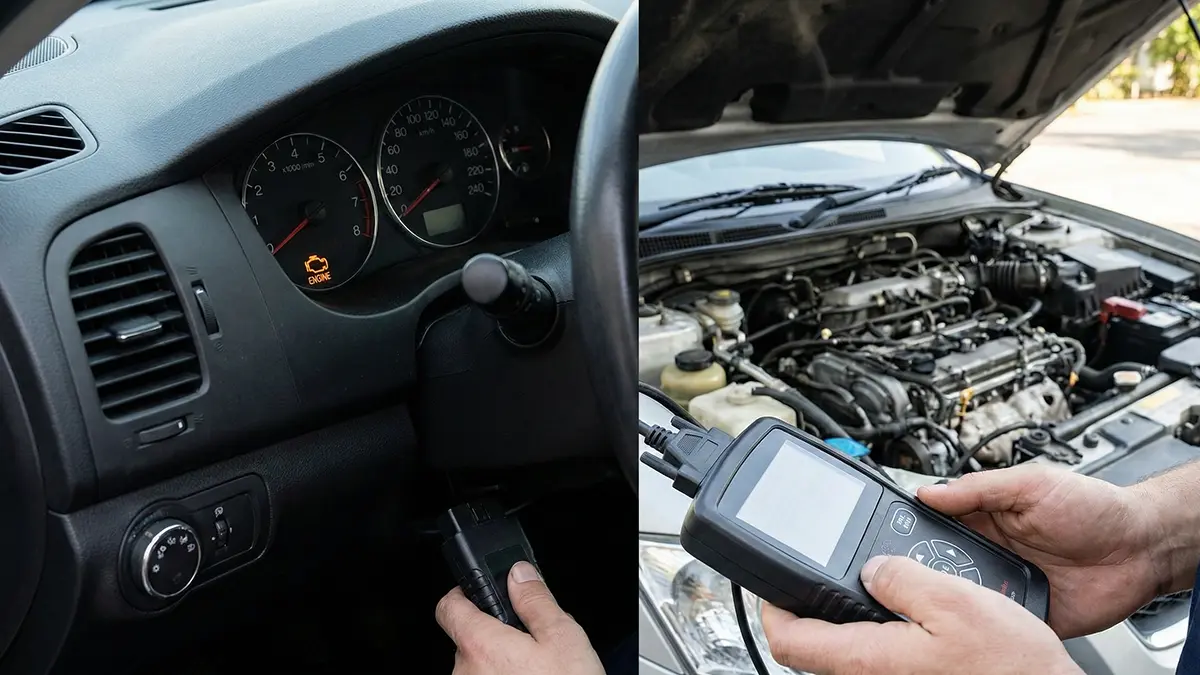
The way the light behaves gives you an important first clue:
- Steady light — A problem exists, but it’s usually not an emergency. You have time to diagnose it properly.
- Flashing or blinking light — This is serious. A flashing check engine light almost always means an active engine misfire is dumping raw fuel into the catalytic converter. Pull over, reduce speed, and get it checked immediately.
Not sure what the light is telling you beyond that? Read our full breakdown: What Does the Check Engine Light Mean?
How to Read Check Engine Light Codes (Step-by-Step)
The fastest and most reliable way to find out why your check engine light is on is to plug in an OBD-II scanner. Here’s exactly how to do it:
- Get an OBD-II scanner — Basic code readers start around $20–$30 and are available at any auto parts store. If you’re going to own a car long-term, it’s worth having one. Not sure which to get? See our OBD-II scanner buying guide.
- Locate the OBD-II port — It’s almost always under the dashboard on the driver’s side, within a foot of the steering column. Look for a trapezoidal 16-pin connector. If you can’t find it, check your owner’s manual — it’ll show the exact location.
- Plug in with the ignition off — Connect the scanner before turning the key. Most scanners power up automatically from the port.
- Turn the key to “ON” (don’t start the engine) — This powers the vehicle’s electronics without running the engine. Some advanced scanners prefer the engine running — follow your scanner’s instructions.
- Select “Read Codes” on the scanner — The scanner will communicate with your car’s ECU and display any stored DTCs.
- Write down every code — Note whether each code is “active” (current problem) or “pending” (detected once, not yet confirmed). Learn more about what pending OBD-II codes mean.
- Research the codes — Use the code list in the next section to understand what each code means.
- Clear codes (optional) — You can clear codes to turn off the light, but only after fixing the underlying problem. Clearing without fixing means the light will return. Here’s how to properly reset your check engine light.
- Disconnect the scanner — Turn off the ignition and unplug the device.
New to OBD-II scanners? We have a beginner-friendly walkthrough: How to Use an OBD-II Scanner for Beginners. Also avoid these common scanner mistakes that give misleading results.
How to Check Check Engine Light Codes Without a Scanner
If you don’t have a scanner, there are a few alternatives. None are as reliable as a proper OBD-II scan, but they can help in a pinch.
Free Code Reading at Auto Parts Stores
AutoZone, O’Reilly Auto Parts, Advance Auto Parts, and most other auto parts stores will read your check engine codes for free. You don’t need to buy anything. Just drive in, tell them the light is on, and they’ll plug in a scanner and print out the codes. This is the easiest no-cost option.
Bluetooth OBD-II Apps
A Bluetooth OBD-II adapter (costs $10–$25) pairs with a free app on your smartphone (like Torque Pro or OBD Fusion) and reads codes wirelessly. It’s a convenient option if you’d rather not buy a dedicated scanner. See our comparison: Bluetooth OBD-II Scanner vs. Handheld.
Check the Gas Cap First
Before doing anything else, check your gas cap. A loose or damaged gas cap triggers an EVAP system leak code (P0440, P0442, P0455) and is one of the most common reasons the check engine light comes on. Tighten the cap until it clicks — or replace it if the seal is cracked. The light may reset itself after a few drive cycles. Learn more: Check Engine Light and Gas Cap.
Understanding Check Engine Light Codes: How DTCs Are Structured
Every diagnostic trouble code follows the same format: one letter followed by four numbers (e.g., P0301). Here’s how to decode them:
The letter indicates the system:
- P (Powertrain) — Engine, transmission, fuel system. This is where nearly all check engine light codes fall.
- B (Body) — Airbags, power windows, door locks.
- C (Chassis) — ABS, traction control, suspension.
- U (Network) — Communication between control modules.
The first number indicates scope:
- P0xxx — Generic (SAE) code, applies to all OBD-II vehicles (1996+)
- P1xxx — Manufacturer-specific code, unique to your car’s make
The remaining three digits identify the specific fault. For the full list, see our complete OBD-II codes list.
Most Common Check Engine Light Codes: Causes and Fixes
These are the codes mechanics and DIYers encounter most often. Understanding them helps you know whether you can fix it yourself or need a shop.
P0300–P0308: Engine Misfire
What it means: The engine is misfiring — one or more cylinders are not firing properly. P0300 means random/multiple cylinders; P0301–P0308 identifies the specific cylinder (e.g., P0301 = Cylinder 1).
Common causes: Worn spark plugs, bad ignition coils, faulty fuel injectors, low compression, vacuum leaks.
Urgency: High — especially if the light is flashing. A severe misfire can destroy your catalytic converter within miles. See: Check Engine Light Blinking When Accelerating.
DIY fix potential: Replacing spark plugs or ignition coils is a common DIY repair. Check the ignition system first.
P0420 / P0430: Catalytic Converter Efficiency Below Threshold
What it means: The catalytic converter isn’t cleaning exhaust gases as efficiently as it should. P0420 = Bank 1, P0430 = Bank 2 (V6/V8 engines).
Common causes: Old or damaged catalytic converter, contamination from oil or coolant, failed oxygen sensors giving false readings.
Urgency: Moderate — the car is driveable, but emissions are higher than legal limits. Don’t ignore it long-term.
DIY fix potential: If the O2 sensor is the actual cause, replacing it is DIY-friendly. A true catalytic converter replacement is a bigger job.
P0171 / P0174: System Too Lean (Bank 1 / Bank 2)
What it means: The engine is running with too much air and not enough fuel.
Common causes: Vacuum leaks, dirty or failed mass airflow (MAF) sensor, weak fuel pump, clogged fuel injectors.
Urgency: Moderate — lean conditions can cause long-term engine damage if ignored.
DIY fix potential: Cleaning or replacing the MAF sensor is DIY-accessible. Finding and fixing vacuum leaks requires more diagnosis.
P0440 / P0442 / P0455 / P0446: EVAP System Leak
What it means: The evaporative emission control system (which prevents fuel vapors from escaping) has a leak. P0455 = large leak, P0442 = small leak, P0446 = vent control issue.
Common causes: Loose or cracked gas cap (most common), cracked EVAP hose, faulty purge valve.
Urgency: Low — this rarely affects driveability, but it keeps your car from passing emissions tests.
DIY fix potential: Start with the gas cap. It’s a $10–$20 fix that resolves many EVAP codes. See: Check Engine Light After Refueling.
P0131 / P0141 / P0136: Oxygen Sensor Malfunction
What it means: One of the oxygen sensors in the exhaust system is failing or reading out of range.
Common causes: Sensor age and heat degradation (O2 sensors typically last 60,000–100,000 miles), exhaust leaks near the sensor.
Urgency: Moderate — a faulty O2 sensor causes reduced fuel efficiency and can lead to a failed catalytic converter over time.
DIY fix potential: O2 sensor replacement is one of the most common DIY jobs. The sensor typically threads in like a bolt.
P0101 / P0102: Mass Airflow (MAF) Sensor Issue
What it means: The MAF sensor — which measures air entering the engine — is reading incorrectly.
Common causes: Dirty sensor (most common), wiring fault, air leak between the MAF and throttle body.
Urgency: Moderate — causes rough idle, poor acceleration, and bad fuel economy.
DIY fix potential: Try cleaning the MAF sensor with MAF-specific cleaner spray first. Replacement is also straightforward.
P0400–P0408: EGR System Malfunction
What it means: The Exhaust Gas Recirculation valve — which reduces NOx emissions — isn’t operating correctly.
Common causes: Carbon buildup blocking the EGR valve, failed EGR solenoid, clogged EGR passages.
Urgency: Low to moderate — mainly an emissions issue, though a stuck-open EGR can cause rough idling.
DIY fix potential: Cleaning the EGR valve is a good first step before replacing it.
For a complete list of all DTC codes and their meanings, see: Full OBD-II Codes List.
What to Do Immediately When the Check Engine Light Comes On
Here’s a clear action plan depending on what you see:
If the light is flashing:
- Reduce speed immediately — don’t floor it.
- Avoid sustained highway driving.
- Get it diagnosed within 24 hours — a severe misfire can ruin a catalytic converter quickly.
- If the car feels very rough or you notice smoke, pull over and call for help.
If the light is steady with no other symptoms:
- Check your gas cap first — tighten it until it clicks.
- Observe the car’s behavior over the next few miles.
- Read the codes as soon as possible (free at any auto parts store).
- You can usually drive normally for a few days while you arrange diagnosis.
If the light is steady AND you notice rough running, loss of power, or smoke:
- Treat this like the flashing light scenario — get it checked promptly.
- See: Check Engine Light and Rough Idle or Check Engine Light On But Car Runs Fine
Steady Light vs. Flashing Light: Urgency Guide
Urgent: Act Within 24 Hours (Flashing Light or Severe Symptoms)
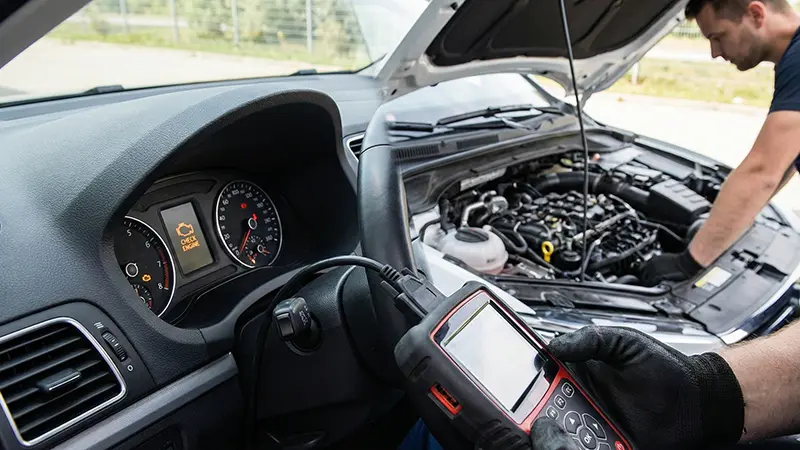
A flashing check engine light signals an active engine misfire severe enough to send raw, unburnt fuel into the exhaust. This overheats the catalytic converter — which can reach over 1,800°F — and can destroy it in minutes of sustained driving. This is an expensive repair that’s entirely preventable.
Other urgent situations requiring immediate attention:
- Significant power loss or inability to accelerate
- Loud knocking or pinging from the engine
- Thick smoke from the exhaust
- Strong smell of burning or raw fuel inside the cabin
- Temperature gauge creeping into the red
Less Urgent: Address Within a Few Days to Weeks (Steady Light, Normal Driving)
A steady check engine light with no drivability symptoms usually means a manageable issue like a loose gas cap, failing O2 sensor, or minor EVAP leak. The car is generally safe to drive short distances, but don’t ignore it indefinitely.
Even “minor” issues left unchecked can lead to:
- Failed emissions inspection
- Gradually worsening fuel economy
- A small problem cascading into a larger one (e.g., an ignored O2 sensor leading to a damaged catalytic converter)
Can You Drive With the Check Engine Light On? How Long Is Safe?
This is one of the most common questions — and the honest answer is: it depends on the code.
- Flashing light: Don’t drive more than necessary. Reduce speed, avoid hard acceleration, and get it diagnosed today.
- Steady light + rough running: Drive carefully and get it checked within 24–48 hours.
- Steady light + normal driving: You can typically drive for a few days or up to a week while you arrange a diagnosis. Don’t make long highway trips.
- After fixing the issue: Clear the codes and reset the check engine light properly so your car’s monitors can complete their readiness checks.
Check Engine Light and Emissions Problems
In most US states, a check engine light automatically means a failed emissions test — regardless of the code. This is because an illuminated MIL signals that the OBD-II monitors haven’t confirmed the emissions systems are working properly.
Common emissions-related codes include the EVAP system codes (P044x) and catalytic converter efficiency codes (P042x). For a deeper dive: Check Engine Light and Emissions Problems.
Common Causes Behind a Check Engine Light: Quick Reference
Here’s a summary of the most frequent check engine light triggers, from most to least common:
- Loose or faulty gas cap — Easy fix, free or under $15
- Oxygen sensor failure — DIY-friendly, $20–$100 for the sensor
- Catalytic converter issue — Can be expensive ($500–$2,500+) if the converter itself needs replacement
- Spark plugs or ignition coils — Moderate DIY job, $20–$150 in parts
- MAF sensor failure — Often fixable with cleaning; replacement is $50–$200
- EVAP system leak — Usually starts with the gas cap; deeper leaks need smoke testing
- EGR valve problems — Often resolved with cleaning; replacement is $150–$400
- Fuel system issues — Range from dirty injectors ($50–$150 to clean) to a failed fuel pump ($400–$600)
Check Engine Light Diagnosis: DIY vs. Professional Help
Reading the code yourself is always a good starting point. But reading the code is not the same as diagnosing the root cause. A code like P0420 (catalytic converter) could point to the converter itself, a failed O2 sensor giving false readings, or an exhaust leak near the sensor. A mechanic with advanced diagnostics can tell the difference before replacing a $1,000 part unnecessarily.
Use our detailed guide for step-by-step diagnosis: Check Engine Light Diagnosis Guide.
When to DIY
- The code points to a simple, well-documented fix (gas cap, O2 sensor, MAF sensor, spark plugs)
- You have the tools and mechanical confidence
- The car is driving normally with a steady light
When to See a Professional
- The check engine light is flashing
- You have multiple codes or codes that don’t make sense together
- The car has noticeable drivability symptoms
- The light keeps coming back after clearing
- The repair requires specialized equipment (smoke test, fuel pressure gauge, oscilloscope)
Preventing the Check Engine Light Before It Comes On
Most check engine light issues are preventable with basic maintenance:
- Follow the manufacturer’s maintenance schedule — Oil changes, spark plugs, air filters, and fluid checks on time prevent most common triggers.
- Always tighten your gas cap until it clicks — This one habit prevents a significant percentage of check engine lights.
- Use quality fuel from reputable stations — Contaminated fuel can trigger multiple engine codes.
- Don’t ignore small symptoms — A rough idle or hesitation under acceleration that doesn’t trigger a light yet can become a check engine issue if left alone. See: Check Engine Light and Rough Idle.
- Address known issues promptly — A misfiring engine from worn spark plugs, if ignored, will eventually damage the catalytic converter and turn a $30 repair into a $1,000+ one.
For a full preventive maintenance plan, see: Check Engine Light Diagnosis Guide.
Frequently Asked Questions
What are the most common check engine light codes?
The most frequently seen codes are P0300–P0308 (engine misfire), P0420/P0430 (catalytic converter efficiency), P0171/P0174 (lean fuel mixture), P0440/P0442/P0455 (EVAP system leak), and P0131/P0141 (oxygen sensor). A loose gas cap triggering EVAP codes is probably the single most common cause overall.
Can I drive with my check engine light on?
It depends on the light’s behavior. A steady light with normal driving conditions generally allows you to drive cautiously for a few days while you arrange diagnosis. A flashing light requires you to reduce speed and get the car checked immediately — continued driving risks destroying the catalytic converter. See our full guide: Check Engine Light On But Car Runs Fine.
How much does it cost to diagnose a check engine light?
Reading the basic codes is free at most auto parts stores (AutoZone, O’Reilly, Advance Auto Parts). A professional diagnostic inspection by a mechanic typically costs $75–$150, which covers not just reading the code but actually investigating the root cause through additional testing. This fee is usually applied to any repair you authorize.
Why does my check engine light come on after getting gas?
This is almost always an EVAP system code triggered by a loose gas cap or overfilling the tank. Tighten the cap until it clicks. The light should reset after a few drive cycles. See: Check Engine Light After Refueling.
Why is both my engine light and traction control light on?
Engine misfires and other powertrain issues can disable traction control as a safety measure, causing both lights to illuminate simultaneously. See: Engine Light and Traction Control Light On.
How do I reset the check engine light after a repair?
You can clear the code using an OBD-II scanner after fixing the underlying problem. Simply clearing the code without fixing the issue will cause the light to return. Some codes also reset automatically after a set number of successful drive cycles. Full instructions: How to Reset Your Check Engine Light.
Are all check engine light codes serious?
No. Some codes like a loose gas cap (EVAP codes) or a slow-responding O2 sensor are minor issues that don’t affect drivability. Others, like active misfire codes (P0300 series) — especially with a flashing light — require immediate action. The code tells you which category you’re in.
Conclusion
The check engine light is your car’s way of asking for attention. It’s not always an emergency — but it’s never something to permanently ignore. The key steps are simple: identify whether the light is steady or flashing, check the gas cap first, read the code (free at any parts store), and then decide whether it’s a quick DIY fix or a job for a professional.
For deeper diagnosis and troubleshooting, use these resources: How to Read Check Engine Codes, Check Engine Light Diagnosis Guide, and our complete OBD-II codes list. The more you understand your car’s warning system, the faster — and cheaper — you can fix problems before they grow.
{“@context”:”https://schema.org”,”@type”:”Article”,”headline”:”Check Engine Light & Codes: Your Complete Guide to Diagnosis & Repair”,”mainEntityOfPage”:”https://autofixnotes.com/?p=770″,”datePublished”:”2025-12-04T18:18:57+00:00″,”dateModified”:”2026-03-04T00:00:00+00:00″}